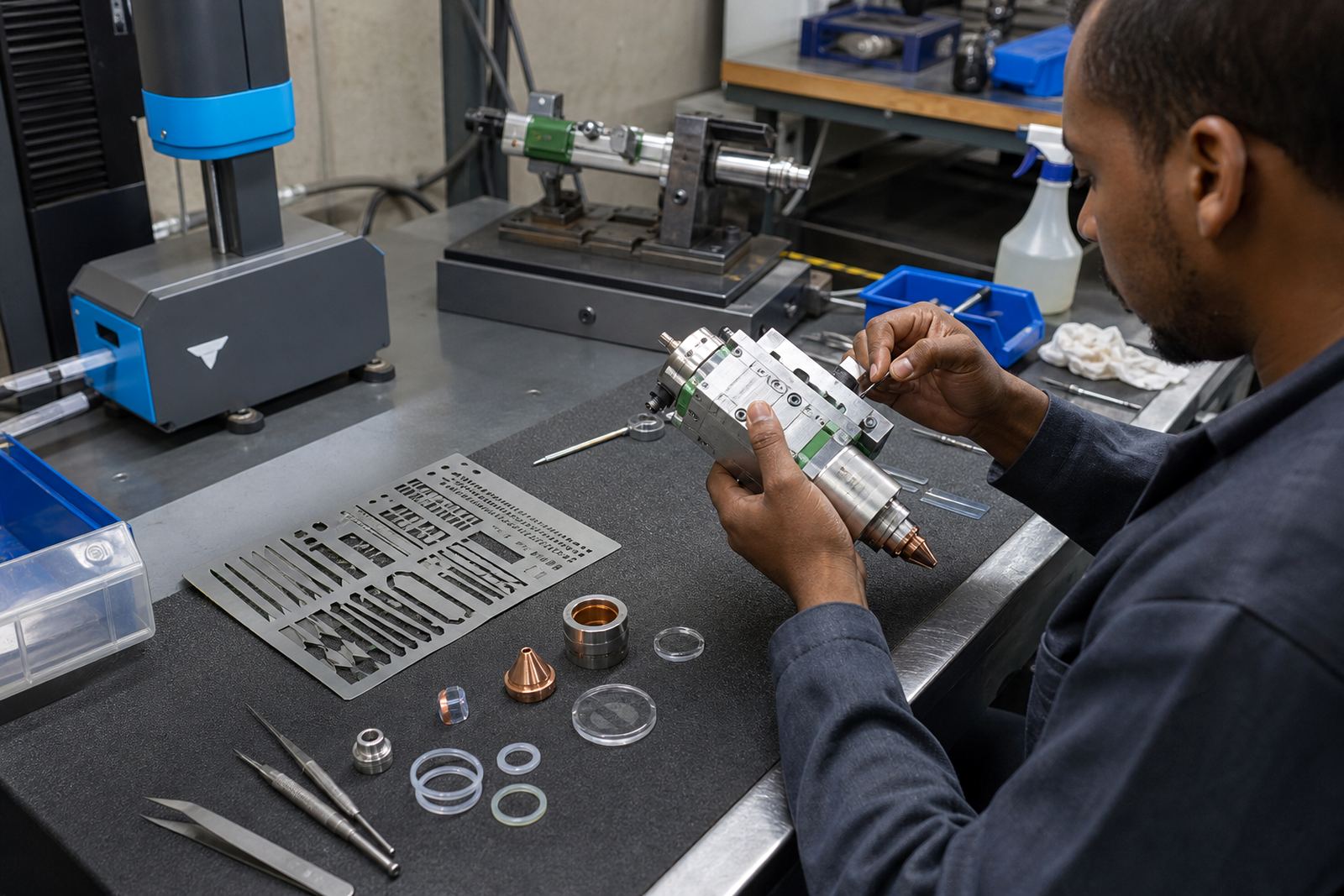
Start With The Head Before The First Sheet Runs
Begin the week with the cutting head parked, cool and clean. Look for dust, spatter marks, loose fittings, heat tint and any sign that the nozzle seat is not sitting true. A fast visual check can show early trouble before it reaches the nest.
On the bench, we usually look at the nozzle condition, the ceramic ring, the protective window and the outside of the head body in one pass. If a crash happened late on Friday, the fresh marks are often easier to see on Monday morning than after a full shift has passed.
- Check the nozzle tip for burrs, oval wear and slag build-up.
- Inspect the ceramic ring for cracks, chips or burnt marks.
- Look at the head body and seal faces for dust tracks or heat staining.
- Wipe external surfaces with a clean lint-free cloth, not a rough rag.
Nozzle Centring Sets The Tone For The Week
Nozzle centring is one of the first jobs that pays off. A centred nozzle keeps the assist gas path even and helps the beam meet the cut point cleanly. If the nozzle is off centre, the kerf can wander and dross often shows up on the underside.
Single layer nozzles suit many general cutting jobs, while double layer nozzles are commonly used where gas flow control needs a different shape. Either type needs the same discipline: check the orifice, keep the seating face clean and replace parts that no longer hold a neat flow pattern.
- Confirm the nozzle sits square in the holder.
- Check that the gas passage is clear and free of carbon.
- Use the correct nozzle size for the thickness and gas choice.
- Reject nozzles with a damaged edge, even if the wear looks minor.
Protective Windows And Lenses Need A Clean View
Protective windows take the first hit from airborne dust and back-spatter, so they deserve a weekly look even when they seem fine from the outside. A cloudy window can scatter the beam and make edge quality drift without warning. Focus lenses and collimator lenses also need careful handling, because fingerprints, fine haze and tiny pits can change how the beam behaves.
Cleaning should be gentle. Use approved optical wipes, proper solvent and a light touch. Never drag grit across the surface. If a window has a stubborn mark that will not lift cleanly, replacement is safer than trying to nurse it through another shift.
- Check for haze, pitting, coloured spots and edge chips.
- Handle lenses by the edges only.
- Keep spare windows sealed until needed.
- Store cleaned optics in a dust-free tray or case.
Focus Settings And Sensor Checks Keep The Cut Predictable
A weekly focus check helps the machine stay set for real work, not just for yesterday's material. Mild steel at one thickness may cut well with one focus point, while stainless or aluminium can need a different setting to keep the cut face tidy. If the focus drifts, the machine may still run but the edge finish often starts to slip.
Capacitive height sensing also deserves attention. A sensor that reads poorly can upset pierce height, cut height and corner behaviour. In practice, that means more scrap and more time spent sorting out a job that should have run cleanly the first time.
- Verify the focus position against the current material mix.
- Check sensor faces for dirt or light damage.
- Confirm the torch or head follows height changes without hunting.
- Watch for cutting marks that suggest unstable stand-off distance.
Ceramic Rings And Gas Paths Carry More Work Than They Look Like
Ceramic rings are not just a spacer. They help the head sit correctly and support electrical and mechanical separation in a compact space. When a ring is chipped or heat stressed, the head can behave inconsistently and small alignment faults become harder to read.
A gas path inspection should sit in the same weekly routine. Look for blocked passages, loose fittings, dirty seals and signs that the assist gas is not moving as it should. In coastal areas such as Durban, humidity can also make dust stick harder to exposed parts, so cleaners and storage matter more than people expect.
- Replace ceramic rings that show cracks or burn marks.
- Check seals for flattening and surface damage.
- Inspect hoses and fittings for leaks or loose joints.
- Keep spare parts dry and packed away from workshop grit.
Spartan sheet-metal week in practice
A shop in the East Rand running mixed mild steel work may start Monday with one head checked on the bench, then send another unit for on-site alignment after a crash during the previous shift. That pattern is common when production moves fast and jobs change thickness through the week. A short routine at the start of the week helps the team spot worn nozzles, dirty windows and a focus setting that no longer matches the current stack of material.
For a branch in Spartan, Kempton Park, the useful habit is to treat optics as weekly consumables, not emergency parts. That means keeping cleaned lenses, spare protective windows, a few nozzle sizes and a fresh ceramic ring set ready before the first cutting run. The same approach works for Johannesburg, Pretoria, Rustenburg and Cape Town when the shop wants steadier edges and fewer surprise stops.
A Clean Routine Is Easier Than A Repair Day
The best weekly routine is plain and repeatable. One person checks the head body, another handles optics, and someone signs off the sensor and gas path inspection before the machine goes back to work. That shared habit keeps small faults from hiding until they become expensive.
Bench servicing and on-site head alignment both fit into that rhythm. A clean lens, a centred nozzle and a checked focus setting are not glamorous jobs, but they shape the quality of every cut that follows.
- Set the same inspection order each week.
- Keep cleaned parts in labelled trays.
- Change worn consumables before they start affecting the cut.
- Record any crash damage or recurring alignment issue.