

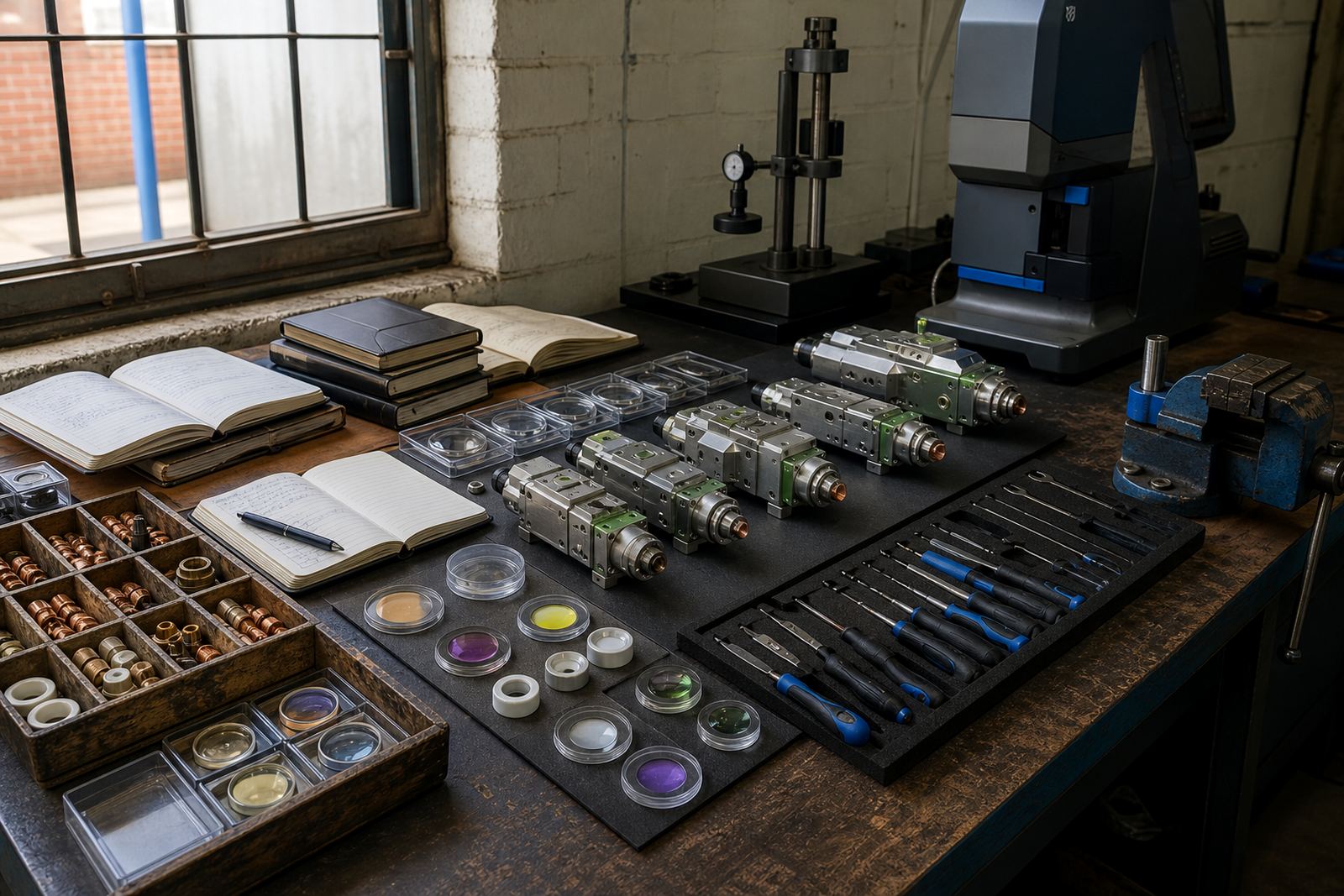
A Spartan workshop built around the cutting bench
We refuse to compromise on keeping laser cutting heads usable, consumables matched to the job, and faults resolved without long stoppages. Based in Spartan, Kempton Park, the team has carried that practical approach through its work in South Africa’s sheet-metal sector. In 1997, Raytool entered a market where fibre laser cutting was still a specialised part of the trade, and those early priorities shaped how the business operates today.
The workshop grew around the parts that matter most on a laser line. Nozzles, focus and collimator lenses, protective windows and ceramic rings all sit in the same practical space as head service and alignment. Customers did not need theory for its own sake, they needed a shop that understood how a dirty window, poor focus setting or a damaged ceramic ring shows up on the cut edge. That kind of work became the centre of the business, not an add on.
Spartan gave the team room for bench work, parts handling and careful inspection. It also placed the business close to the East Rand manufacturing corridor, where sheet-metal shops often need parts, checks and repair work handled with little fuss. The same base still anchors the operation today, with service reaching Johannesburg, Pretoria, Durban, Cape Town and Rustenburg as well.
The craft grew from wear points, not sales talk
As the work widened, the team learned to read the small signs that shape cut quality. A nozzle opening that has started to wear, a lens with residue, or a protective window marked by spatter can all show up as unstable cutting. Ceramic rings and capacitive sensing also became part of the routine, because head movement and sensing accuracy affect more than people often expect. The business grew by paying attention to those details, not by chasing fancy language.
That is why the service list expanded in a sensible order. Bench Head Service came first, then on-site head alignment, nozzle centring, focus setting check and protective window replacement. Lens cleaning, ceramic ring replacement, capacitive sensor check, gas path inspection and head seal rebuild followed naturally because they solve the problems that turn up in real shops. Crash damage inspection and spare head preparation round out the work for customers who need a practical backup plan.
- Single and double layer nozzles are handled as working parts, not throwaway items.
- Focus settings are checked with the cut in mind, not just the manual.
- Protective windows are treated as consumables that need clean handling.
- Gas paths and seals are inspected when airflow issues show up in the cut.
- Capacitive sensing is checked where height control starts to drift.
Who uses the parts and service now
The customers are sheet-metal shops that live with fine tolerances, mixed material thicknesses and real production pressure. Some run high-volume jobs, others cut short batches, repair work or one-off fabrications. What they have in common is the need for a cutting head that stays aligned, clean and predictable. A small change at the nozzle or lens can affect the cut edge, pierce quality and how much scrap ends up in the bin.
Raytool works with teams that already know the cost of poor cut quality. That includes shops in industrial areas around Johannesburg and the East Rand, fabrication teams in Pretoria and Rustenburg, and coastal operations in Durban and Cape Town where humidity can make cleaning routines more important than people first assume. The parts and service side has grown by listening to those conditions and by supplying what fits the machine and the work, not what sounds impressive in a brochure.
The business still deals in the small but critical items that keep a machine honest. Nozzles must be centred correctly, lenses must be clean and seated properly, and protective windows need careful handling to avoid recurring marks. The team has built its reputation on being useful in those moments when a machine is not fully down, but not quite right either.
How the team keeps the work orderly
Raytool is run by a compact team with clearly split responsibilities, which helps when a job moves between the shop floor and the field. Marius Johannes van der Merwe heads the business as Managing Director. Thandiwe Rapetswa keeps operations in order, Jaco Essop handles bench service, and Lerato Tau takes care of field alignment. Anele Daniels manages parts sales, while Willem Pretorius leads technical support.
That structure matters because fibre laser heads do not always need the same kind of attention. Some units can be stripped, cleaned and checked on the bench. Others need on-site alignment because removing the head would take too much time or disturb a production run. The team uses that split to decide how a fault should be handled, and to keep the work practical for the customer’s machine and schedule.
- Bench work is used for controlled checks, cleaning and rebuilds.
- Field work is used when alignment needs to happen on the installed machine.
- Parts are matched to the head and the cutting job, not just the part number.
- Technical support stays close to the realities of cut quality and wear.
- Each job is handled with the same focus on fit, cleanliness and alignment.
The details that matter on a laser line
Much of the craft sits in details that are easy to overlook. A clean focus lens is one thing, but the spacing, seating and handling around it matter just as much. A collimator lens has to hold its role in beam delivery, while the protective window stands in front of the more expensive parts and takes the abuse first. When the window is marked, the whole system can start to drift in performance.
Cleaning routines also became part of the business story because a fibre laser head can look fine at a glance while still carrying residue in the wrong place. Dust, fine metal particles and cutting by-products all build up over time. The team treats lens cleaning, nozzle inspection and ceramic ring replacement as regular maintenance rather than emergency work. That habit has helped keep machines running in better shape for longer stretches.
On-site alignment added another layer to the business. Some customers needed support where the machine stands, especially when travelling time matters or when a head needs to be checked in its working position. That field work gave the service side a broader reach across South Africa and made the Spartan base more than a parts counter. It became a support point for the trade.
What the business has become without changing its bones
Raytool today is still shaped by the same practical habits that formed it in the beginning. The business supplies fibre laser cutting heads, nozzles, focus and collimator lenses, protective windows and ceramic rings, while also handling bench service and on-site alignment. The range is wider now, but the idea is unchanged: help sheet-metal shops keep their cutting heads clean, aligned and usable.
That mix of parts and service suits customers who need more than a parcel of consumables. They need someone who understands how capacitive height sensing affects cut consistency, how a head seal rebuild fits into a larger fault, and how crash damage can hide deeper alignment issues. The team works with that level of detail because the work demands it and the machines do not forgive guesswork.
People contact the team through our form on the contact page when they need help with parts or service support. From Spartan, Kempton Park, the business continues to serve Johannesburg, Pretoria, Durban, Cape Town, Rustenburg and the East Rand with the same practical rhythm that started the story in the first place.