

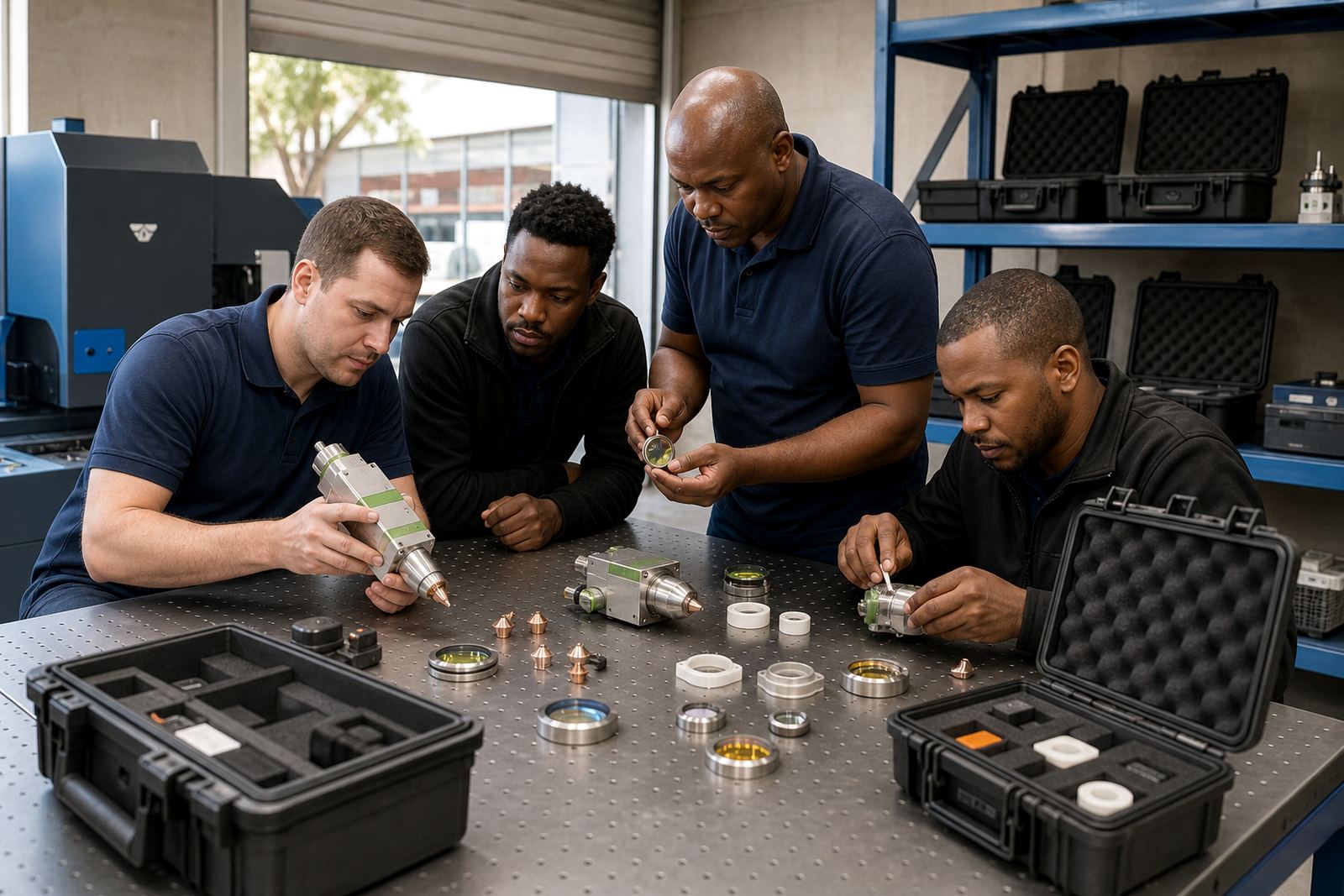
A Spartan workshop built around cutting heads
Raytool has operated from Spartan, Kempton Park, in Gauteng’s fast-moving sheet-metal sector, where every lost hour on a fibre laser can slow production. Our workshop is set up around the parts and checks that help laser cutting heads perform as they should, from nozzle changes to lens handling and head alignment. The work is hands-on, exact and centred on the cut edge, because that is where faults usually appear first.
We support shops that run flat sheet jobs on machines fitted with fibre laser heads. That includes handling single layer and double layer nozzles, focus and collimator lenses, protective windows, ceramic rings and the parts around the capacitive sensing system. A head that is clean, centred and correctly set cuts straighter, keeps the kerf stable and helps reduce scrap from burned edges, dross and stray spatter.
- Base: Spartan, Kempton Park
- Work area: Johannesburg, Pretoria, Durban, Cape Town, Rustenburg and the East Rand
- Main parts: heads, nozzles, lenses, windows and ceramic rings
- Service formats: bench work and on-site alignment
What the bench service actually pays attention to
On the bench, the focus is on the pieces that wear, shift or collect residue. A nozzle can lose its edge, a protective window can fog or pit, and a ceramic ring can crack after a crash or a rough cut. The same is true for the lens stack. Small marks on a focus lens or collimator lens can affect beam quality and the cut face, even when the machine still looks ready to run.
We clean, inspect and reset the head in a sequence that reflects how fibre laser systems behave in daily production. That means checking the gas path, looking at nozzle centring, confirming the focus setting, inspecting seals and checking the sensing parts that help keep stand-off stable. If the head has taken impact or shows heat damage, the inspection goes further and the damaged parts are separated before the head goes back into service.
- Bench Head Service
- Nozzle Centring
- Focus Setting Check
- Protective Window Replacement
- Lens Cleaning
- Ceramic Ring Replacement
On-site alignment for machines already in production
Not every head can be pulled from the machine and sent away. Some jobs need direct alignment where the machine stands, especially when the operator is dealing with repeat cutting faults, poor pierces or a head that drifted after a collision. Our field work is built for that reality. We arrive with the tools needed to check alignment, inspect the sensor behaviour and set the head back into a usable range without guessing.
On-site alignment is especially useful where a shop runs large sheets, narrow schedules or mixed material thicknesses. A head that is slightly out can show up as taper, uneven piercing or a noisy cut path, and those faults tend to waste both material and gas. We look at the cutting head, the nozzle condition, the sensing path and the focus position together, because the problem is often a combination rather than one single fault.
- On-site Head Alignment
- Capacitive Sensor Check
- Gas Path Inspection
- Crash Damage Inspection
- Spare Head Preparation
How we work with parts, wear and cleaning routines
Laser heads are sensitive to contamination. Dust, smoke residue and metal vapour can settle on the wrong surface and cause a slow loss of quality. That is why cleaning routines matter just as much as replacing a worn part. We handle protective windows with care, keep lens surfaces clean, and check the ceramic ring and nozzle seat so the head stays steady under load.
The same attention applies to focus settings. A setting that drifts even a little can change the cut edge, especially on thicker sheet or reflective material. We look at the optical path, the centring of the nozzle and the condition of the sensor parts together. When a shop is trying to keep a machine productive, small details matter more than long explanations, so our process stays direct and clear.
- Focus and collimator lenses are treated as precision parts
- Protective windows are checked for haze, pits and heat marks
- Nozzles are assessed for wear, burrs and centring faults
- Cleaning is done to protect beam quality and cut consistency
The people behind the counter and the bench
Raytool is run by a small team with clearly defined jobs. Marius Johannes van der Merwe oversees the direction of the business. Thandiwe Rapetswa coordinates operations and keeps the flow between the shop, the bench and the field work steady. Jaco Essop handles bench service, while Lerato Tau carries out field alignment work where the machine stands. Anele Daniels looks after parts sales, and Willem Pretorius leads the technical support side of the work.
That structure matters because fibre laser support is not one task. One person may be tracing a nozzle fault, another may be preparing a spare head, and someone else may be checking a lens set before a job leaves the bench. The team works around the parts and the machine condition, not around guesswork. That keeps the process practical for sheet-metal shops that need direct answers from people who understand the hardware.
- Marius Johannes van der Merwe, Managing Director
- Thandiwe Rapetswa, Operations Coordinator
- Jaco Essop, Bench Service Technician
- Lerato Tau, Field Alignment Technician
- Anele Daniels, Parts Sales Consultant
- Willem Pretorius, Technical Support Lead
What our clients usually bring to us
Most shops do not arrive with a single clean fault. They bring a pattern of symptoms: poor cut quality on one thickness, erratic piercing on another, a head that has taken a knock, or a nozzle that is no longer holding concentricity. We work through the parts in the order the fault suggests, starting with the visible wear and moving deeper into the head if the problem calls for it.
Customers in Johannesburg, Pretoria, Durban, Cape Town, Rustenburg and the East Rand often need a mix of parts and service. Some need a protective window and a fresh nozzle, others need a full bench service after a crash, and some need alignment on the machine because the fault is tied to the way the head is sitting in production. Our contact form is the entry point for those jobs, especially when a head needs to be described carefully before it is moved or opened.
- Typical fault areas: cut quality, piercing, alignment and contamination
- Typical parts: nozzles, windows, ceramic rings and lens sets
- Typical work mix: bench service, field checks and spare head preparation
The standards we keep across every job
Our work stays focused on the condition of the head and the result at the cut edge. We do not dress that up. If a nozzle is worn, it gets treated as a worn nozzle. If a protective window has marks, it gets inspected and changed where needed. If the sensing path is unstable, the check moves to the parts that affect stand-off and focus. That kind of order helps a shop keep production moving without chasing the same fault twice.
Raytool serves shops that already know how unforgiving a fibre laser machine can be. Humidity near the coast in Durban and Cape Town can change storage and cleanliness needs, while inland dust and handling wear appear in different ways. We keep our eye on the practical side of the work: clean parts, correct centring, sound seals and a head that is ready for the next cut. That is the level of care we bring to every bench job and every on-site alignment.
- Keep the head clean, centred and inspected
- Match the part to the fault, not the other way round
- Check wear before it becomes machine downtime
- Protect the optical path from dust, smoke and handling damage