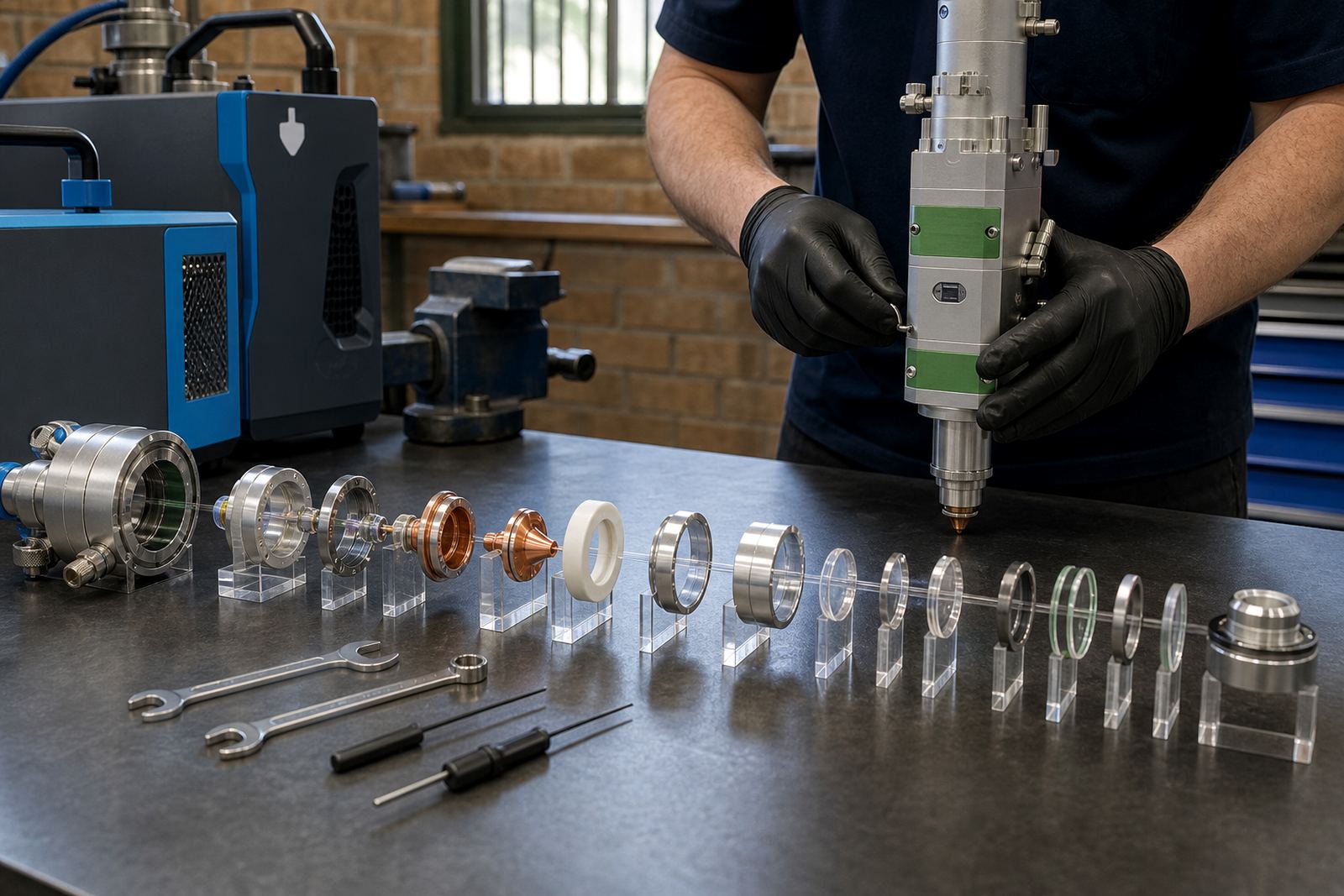
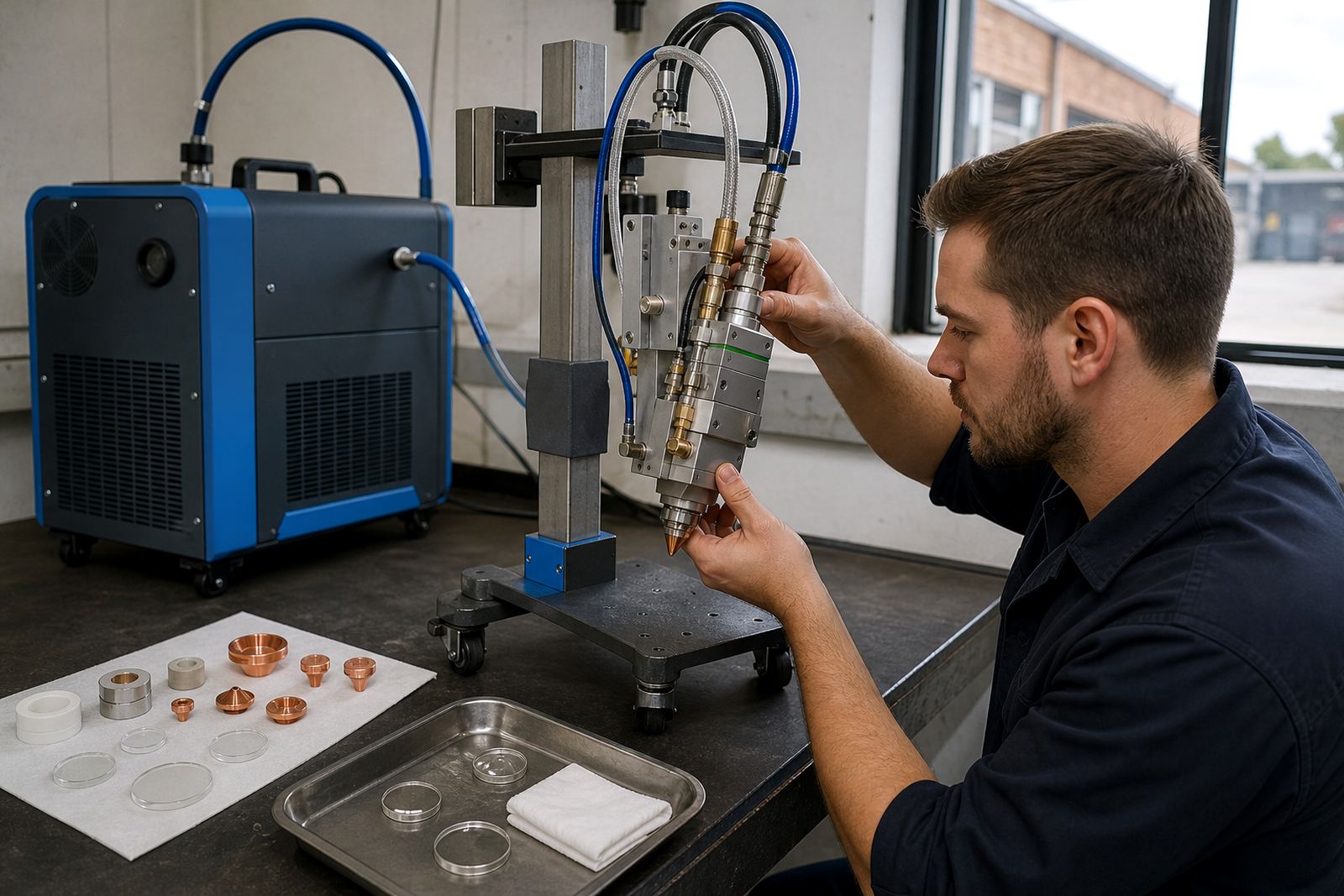
When molten metal starts climbing back toward the head
Spatter is not only a cutting edge problem. When the melt pool is too large, the assist gas does not clear it cleanly and droplets can travel upward, then sit around the nozzle, ceramic ring and lower protective window. In a busy sheet-metal shop that makes short runs and frequent material changes, that build-up can turn from a light dusting into a sticky layer that affects beam quality and nozzle centring.
The first sign is usually a change in cut sound or a line that needs more cleaning than usual. If the machine is cutting 1 mm or 3 mm mild steel one hour and stainless the next, the cut data can drift a little and leave more molten spray than the head was set up to handle. On coastal jobs, humidity can add another layer of trouble because residue attracts more dirt and film on the window.
Gas pressure and nozzle condition carry more of the load than many shops expect
A nozzle that is partly blocked, out of round or the wrong size for the sheet thickness can send gas sideways instead of straight through the kerf. Once that happens, the melt is not blown clear and spatter begins to bounce back toward the lower part of the head. Single layer nozzles and double layer nozzles each need the right fit, not just a quick swap from the spares tray.
- A nozzle with burrs at the tip can disturb the gas cone.
- Too much pressure may splash melt rather than guide it out of the cut.
- Too little pressure leaves heavier droplets sitting in the kerf.
- Wrong stand-off distance can let spatter travel back onto the nozzle face.
We often see this after a period of mixed production, where a job that needed fine detail is followed by heavier plate work without a proper setup check. That small mismatch is enough to leave carbon, metal dust and splash marks around the cutting head.
Focus, height and pierce settings shape where the splash ends up
Spatter does not only rise because of heat. If the focus setting is too high or too low for the job, the beam can open the kerf in the wrong place and throw molten material upward instead of down through the cut. Capacitive height sensing also matters here, because a noisy sensor signal or a dirty sensing path can make the head hunt for height and change the cut gap from one point to the next.
Pierce settings need care as well. A long pierce on thin sheet can splash back hard, while a short pierce on heavier sheet may leave slag clinging to the edge and throwing more debris into the head area. That is why a focus setting check and a capacitive sensor check are part of normal head service work, not extra polish on top. On a panel line in East Rand, a slight height drift over several sheets can be enough to mark the protective window before the operator notices the pattern.
A dirty lower window often points to a bigger routine gap
Protective windows do not usually fail on their own. They get dirty because spatter, vapour and fine dust keep landing on the same surface, especially when cleaning routines are irregular or the gas path has minor contamination. Once a window is marked, the beam can scatter, heat build-up rises and the next layer of dirt sticks faster.
Many shops only notice the problem when the cut starts looking dull or the head needs frequent attention. By then, the ceramic ring may already show heat marks and the lens cavity can carry fine residue. A proper lens cleaning and protective window replacement sequence helps, but only if the rest of the head is checked at the same time. That includes the seal, nozzle seating and any sign of crash damage that may have shifted the body out of line.
Cleaning routines that help before the build-up gets stubborn
Good cleaning is not a wipe and hope job. It means stripping the head in a clean bench area, checking each optical surface, and replacing parts that no longer sit true. For shops in Johannesburg, Pretoria and Durban, the dust load and production pace can make this routine more important than people first think. A head that is only half-clean often comes back with the same spatter marks after a few shifts.
- Keep the nozzle face clean and centred before long runs.
- Inspect the lower window for heat haze, pits and fine dust.
- Check the ceramic ring for cracks, burn marks or loose fit.
- Confirm the focus and collimator lenses are clean and seated correctly.
- Review assist gas delivery for leaks, moisture or unstable flow.
That kind of routine is part of bench head service in Spartan, Kempton Park, and it also supports on-site head alignment when the machine cannot be lifted out of production for long. The aim is not to overwork the head, just to keep the cutting path clean enough for steady production.
A Rustenburg job that showed how small errors stack up
A Rustenburg sheet-metal shop recently had repeated spatter on the nozzle area after switching between light gauge and thicker carbon steel. The cut edges were still serviceable, but the lower window kept fouling and the operator had to clean the head more often than normal. The issue was not one single fault. The nozzle size was slightly off for part of the work, the focus setting had drifted, and the sensor path needed a clean and check.
Once the head was stripped on the bench, the team found residue around the ceramic ring and a lower window that had started to cloud. After nozzle centring, lens cleaning, a protective window change and a proper focus setting check, the spatter pattern settled back to a normal level. That is the point worth remembering: spatter at the head is usually a process story, not just a dirty part story. When the gas path, height sensing and cut data all line up, the head stays cleaner and the lower window lasts longer.
For shops across South Africa, from Cape Town to Pretoria and the East Rand, that kind of pattern is common on fibre laser cutting machines. The fix is rarely a guess. It is a measured check of the nozzle, focus, sensing and cleaning routine, with spare head preparation ready when wear is no longer worth stretching.