

What the nozzle is actually doing at the cut
The nozzle is more than a small copper part with a hole through it. On a fibre laser cutting head, it shapes the assist gas stream so the jet meets the melt pool in a clean, controlled column. When that stream is centred around the beam, the cut behaves the way the settings expect it to. When it is off centre, the gas pushes unevenly and the cut face starts telling a different story.
In practical terms, nozzle centring affects how the gas clears molten material from the kerf. A centred nozzle supports cleaner pierce starts, steadier edge quality and less wandering on sharp corners. Poor centring can show up as dross on one side, heat marks that lean one way, or an edge that looks acceptable on a straight run but changes when the head moves through detail work.
Most sheet-metal shops notice the problem first on thinner material, where the process has less room for error. A small offset can disturb the gas cone enough to alter pressure at the cut face. On stainless, mild steel and aluminium, the signs differ, but the cause often begins at the nozzle seat, the ceramic ring, or a head that has taken a knock and is no longer running true.
What poor centring does to gas flow
Gas flow in a fibre laser head needs symmetry. If the nozzle is not centred to the beam path, the gas stream leaves the orifice unevenly and the flow pattern becomes lopsided. That can reduce cutting efficiency because the assist gas is no longer clearing molten metal in a balanced way. Instead of a straight, narrow column, the jet can fan to one side and lose force where it matters most.
That uneven flow often leads to a few familiar symptoms:
- one-sided dross that clings to the lower edge of the cut
- larger burrs on corners or tight radii
- burn marks that show a directional lean
- pierces that spit more than they should
- extra noise and turbulence at the nozzle tip
A miscentred nozzle can also force operators to chase settings that should not need chasing. They may raise gas pressure, alter focus or slow the programme, only to find the real problem is mechanical rather than procedural. That is why centring is worth checking before the job starts to drift into waste and rework.
The parts around the nozzle that matter
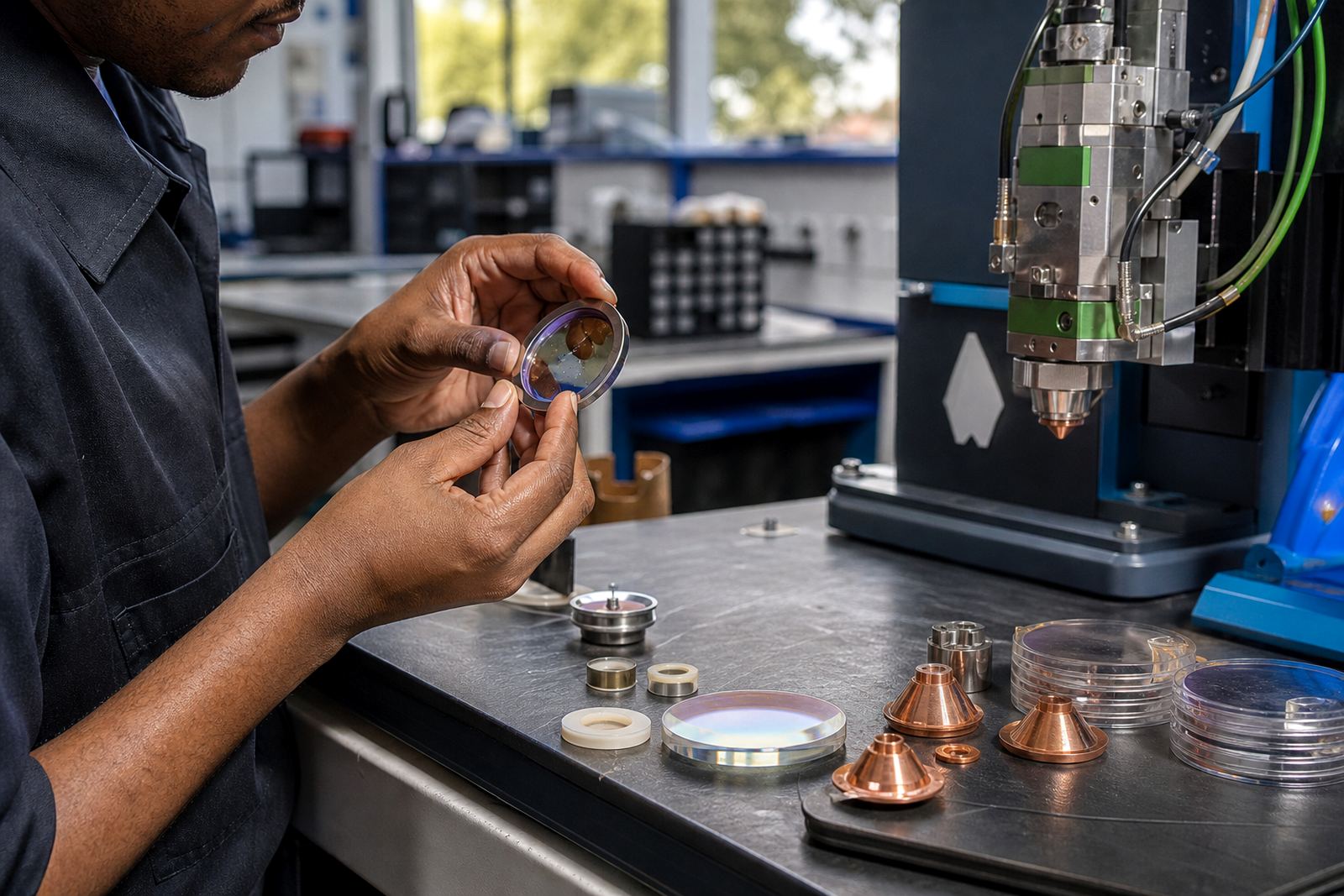
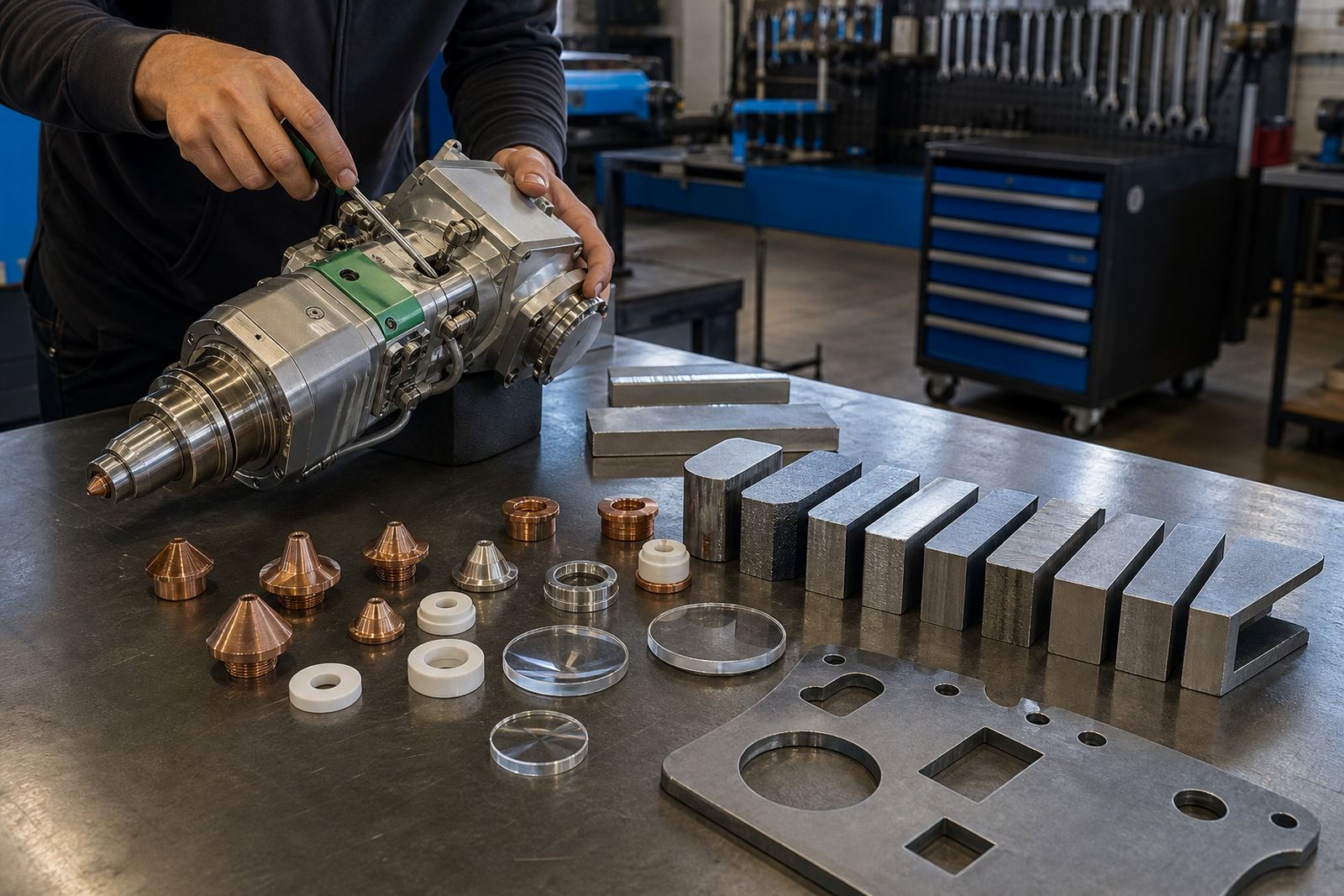
Nozzle centring does not sit alone. The ceramic ring supports the nozzle body and helps keep the head insulated and aligned, while the lens stack inside the cutting head must stay clean and seated correctly. If the ceramic ring is cracked, the nozzle can sit slightly off axis. If the protective window is dirty or heat-marked, the beam path can become unstable and make centring checks less reliable.
Focus setting also plays a part. A head can look mechanically centred but still cut poorly if focus has drifted. That is why a good check looks at the whole path, not only the nozzle tip. On many fibre laser heads, capacitive height sensing depends on clean geometry and consistent distance from the work surface. When the nozzle is worn, the sensing signal can become noisy and the machine may struggle to keep the stand-off steady.
- inspect the nozzle face for nicks or uneven wear
- check the ceramic ring for cracks or carbon marks
- look at the protective window for spatter and haze
- confirm the focus position after any head service
- verify that the head body sits square after a crash
Bench checks that catch the small errors early
In the workshop, nozzle centring is usually checked with the head secured and the beam positioned through the nozzle in a controlled way. The aim is to see whether the beam is sitting on the centreline of the nozzle or drifting to one side. A technician will also look for signs of wear around the seat, the seal, and the internal components that keep the head stable under cutting conditions.
Cleaning routine matters here too. Dust, fine slag and smoke residue can build up around the nozzle holder and hide the real fault. A careful clean should leave no grit in the seating faces and no residue on the window or lens path. If the head has been cleaned in a rush, the nozzle can seat badly and the same cut faults return the next shift.
Our bench service work in Spartan, Kempton Park often includes nozzle centring together with lens cleaning, protective window replacement and a check on the ceramic ring. That combination is practical because one worn part can mislead the whole diagnosis. A nozzle might be blamed for a gas-flow issue, when the ring or seal is the part moving out of line.
On-site alignment on real shop floors
On site, the picture changes a little. Machine frames can sit on uneven floors, heads can pick up a knock during loading, and a small alignment shift can creep in after routine maintenance. In a busy Johannesburg or East Rand shop, operators may notice that one machine cuts clean while another needs more cleaning, more sanding and more gas to finish the same programme. That difference is often worth tracing back to head alignment and nozzle centring.
Durban coastal humidity can also change how residue behaves around the cutting head. Moist air and fine dust can leave deposits that build up faster than expected, especially near the nozzle and protective window. In Cape Town and Rustenburg, different workshop conditions create their own patterns, but the principle stays the same: if the head is not centred, the gas path is not doing its job evenly.
On-site checks are useful when the machine is already part of a production line and the problem needs to be seen in context. The technician can inspect the gas path, confirm the head seal, check for crash damage and set the head back into a working position without guessing from a bench-only view.
A practical habit for sheet-metal teams
Good nozzle centring is never a once-off job. It works best as part of a short routine that includes a visual check, cleaning and a quick look at the cut edge before a long run starts. If the nozzle has been changed, if the head has hit the sheet, or if cut quality has shifted without a clear reason, centring should be checked again.
For many shops, the most useful habit is simple: keep a record of which nozzle was fitted, what material was being cut and what the edge looked like after the first test pieces. That makes it easier to spot a pattern when the same fault appears on mild steel one week and stainless the next. It also helps the team separate nozzle wear from lens contamination or a focus change.
- check nozzle condition before long production runs
- clean seating faces before refitting parts
- watch for directional dross after the first sample cut
- inspect the head after any crash or unusual noise
- treat repeated edge faults as a centring and alignment issue first
The job the cut edge is trying to tell you
A fibre laser cut edge gives clues early. If one side looks hot, rough or overloaded with dross, the nozzle may be out of centre and the gas stream is no longer striking the kerf the way it should. That does not always mean the nozzle itself is defective, but it does mean the head needs attention before the fault spreads through a batch.
In a working sheet-metal shop, nozzle centring is one of those small checks that saves time later. It supports cleaner cutting, steadier gas use and less trial-and-error on the machine. When the centring, focus and cleaning routine are in step, the head stays predictable and the operator spends less of the shift correcting a problem that should have been caught at the start.