Why thick plate tightens the cutting window
Once sheet moves into heavier gauges, the cut is less forgiving. The kerf stays under more heat for longer, molten metal has farther to travel, and the assist gas has to clear a deeper channel without throwing dross back onto the face. That is where focus setting starts to matter in a very practical way, because a small change at the lens can show up as rough edges or a cut that falls short in one corner of the bed.
On lighter work, a machine can hide a fair amount of drift in nozzle centring or lens condition. Thick sheet does not hide much. If the beam is slightly off axis, or the protective window carries a haze from spatter, the cut edge often tells the story before anyone opens the head. For shops in Spartan, Kempton Park and the East Rand, that shows up most often on repeated runs of carbon steel where the job still looks stable on the screen but the edge quality starts moving on the floor.
Focus on thicker material is not only about moving the focal point up or down. It is about keeping the whole head in a state where the beam, gas stream and standoff distance line up cleanly. When that balance slips, the machine may still cut, but it begins asking more from the operator than the job should need.
The nozzle and gas pattern do the heavy lifting
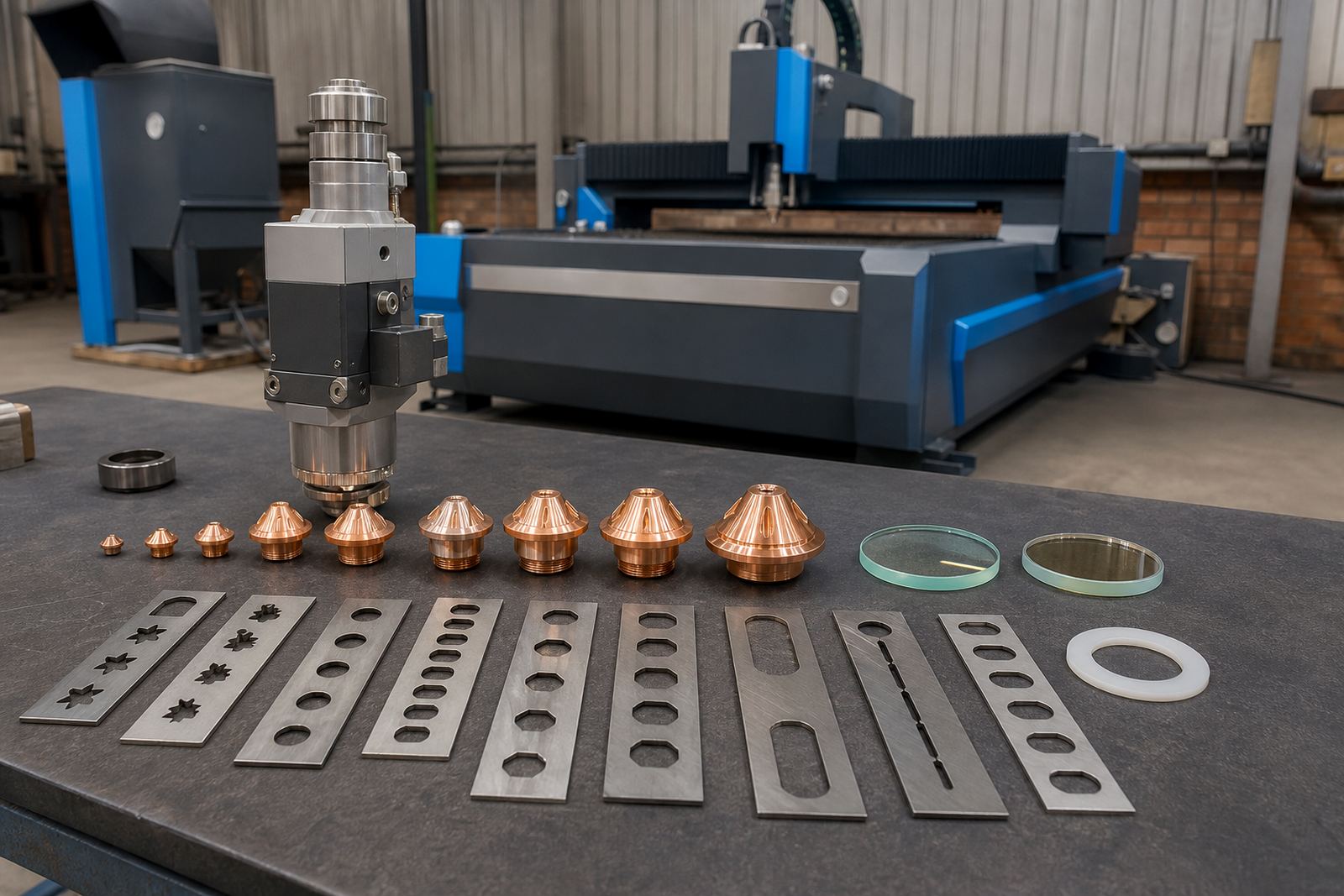
Single layer and double layer nozzles behave differently under load. A single layer nozzle can give a neat, direct gas column for certain jobs, while a double layer type is often used where the gas stream needs more control and steadier flow. On thick sheet, nozzle condition and centring matter because the gas has less room to correct a bad start. Even a small burr at the nozzle tip can disturb the stream enough to leave heavy dross or a wider heat-affected edge.
The gas setup has to suit the material, thickness and cut goal. Oxygen cuts on thicker mild steel need a different practical approach to focus than nitrogen cutting on stainless or aluminium, and the nozzle opening has to match that choice. Too much pressure can blow molten metal where it should not go. Too little pressure leaves stubborn slag hanging under the sheet.
- Check that the nozzle sits concentrically to the beam, not just visually but under proper alignment.
- Keep the nozzle face clean, especially after a crash or a long run with spatter.
- Match nozzle size to thickness, gas type and cut speed rather than using one size across all jobs.
- Inspect the ceramic ring if the head starts drifting or the stand-off feels inconsistent.
Focus is a setting, not a guess
On thick sheet, focus setting works best when it is treated as part of the cut recipe rather than an afterthought. The right focal position depends on metal type, sheet thickness, assist gas and the cut style the machine is trying to hold. A setting that is fine on 3 mm plate can produce very different results on 12 mm or 20 mm if the head is left untouched.
Operators sometimes chase edge quality by changing speed alone. That can help for a short run, but if focus is out the cut may still show taper, striations or lower edge buildup. A proper focus check looks at where the beam sits inside the kerf, whether the top edge is clean, and whether the bottom edge is clearing cleanly without excessive heat load. The best result is usually a controlled compromise rather than the most aggressive setting on the machine.
In Durban, where humidity can make cleaning habits matter more often, a head that has been left with residue on the window or lens can make focus behaviour less predictable. The machine does not need drama to drift out of cut, just a little contamination and a few poor assumptions about the setup.
When lenses and windows start to shape the cut
Focus and collimator lenses do not fail loudly in every case. More often they age into inconsistency. A slightly clouded protective window, a focus lens with residue around the edge, or a collimator lens that has been exposed to heat and dirt can all change how the beam behaves when it reaches thick material. The machine may still fire cleanly, but the cut quality can turn uneven from one section of the nest to the next.
Cleaning routines are part of the job. They need light pressure, the correct fluid, clean wipes and a calm hand. Scrubbing a coated lens is a fast way to create a new problem. If the window is marked, pitted or showing spatter damage, replacement is usually better than trying to coax another shift out of it. The same applies when the head has taken a light crash and the optical path no longer feels centred.
- Look for a dull film on the protective window before chasing machine settings.
- Replace damaged ceramic rings that no longer hold the nozzle in a stable position.
- Keep the lens stack clean and seated correctly, with no dust trapped at the edges.
- Use cleaning routines that suit coated optics, not shop rags and guesswork.
Capacitive sensing has to stay honest
Thick sheet puts more pressure on capacitive height sensing because the head must hold a stable stand-off while the sheet itself may have minor warp or scale. If the sensor is off, the head may track too high or too low, and that changes the gas flow right where the cut needs it most. The result can be a cut that starts well and then goes uneven once the bed, sheet and head settle into a long pass.
Sensor checks matter after a collision, after nozzle changes and whenever the cut height begins wandering without an obvious reason. A clean sensor path, sound ceramic ring and stable head geometry make the rest of the setup easier to trust. In Johannesburg and Pretoria, where many shops run mixed work across different thicknesses, this check becomes part of the daily routine rather than a repair only done after damage.
For thick plate, the operator is not only watching sparks. The real signal is whether the head keeps its distance and the cut continues with the same tone and finish through the full length of the job.
A Pretoria job with thicker mild steel
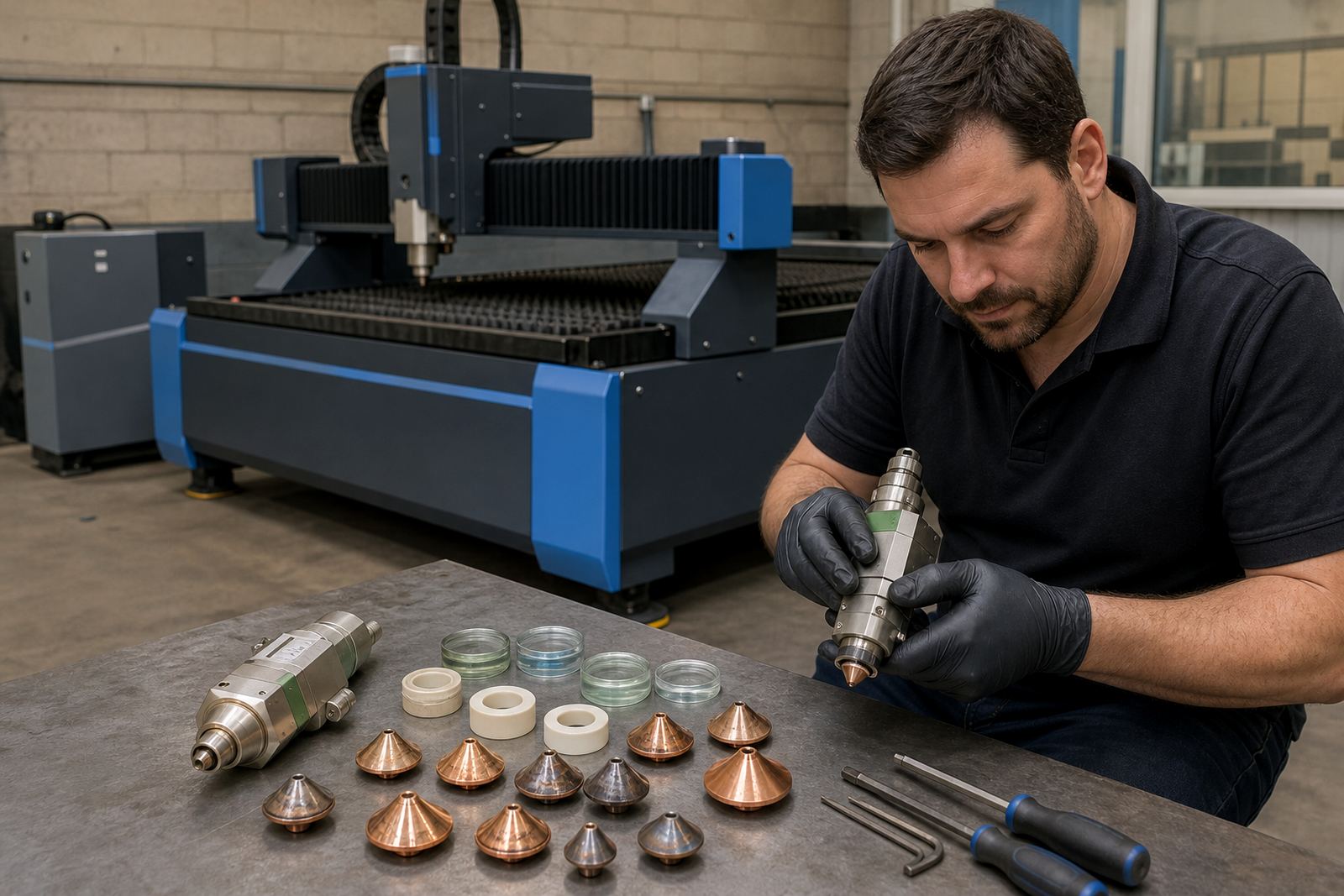
A sheet-metal shop in Pretoria brought in a head that still cut lighter work without complaint but struggled on thicker mild steel. The top edge looked acceptable, yet the bottom carried heavy dross and one side of the nest was worse than the other. After checking the nozzle centring, the protective window and the focus setting, the issue pointed back to a mixed problem rather than a single fault.
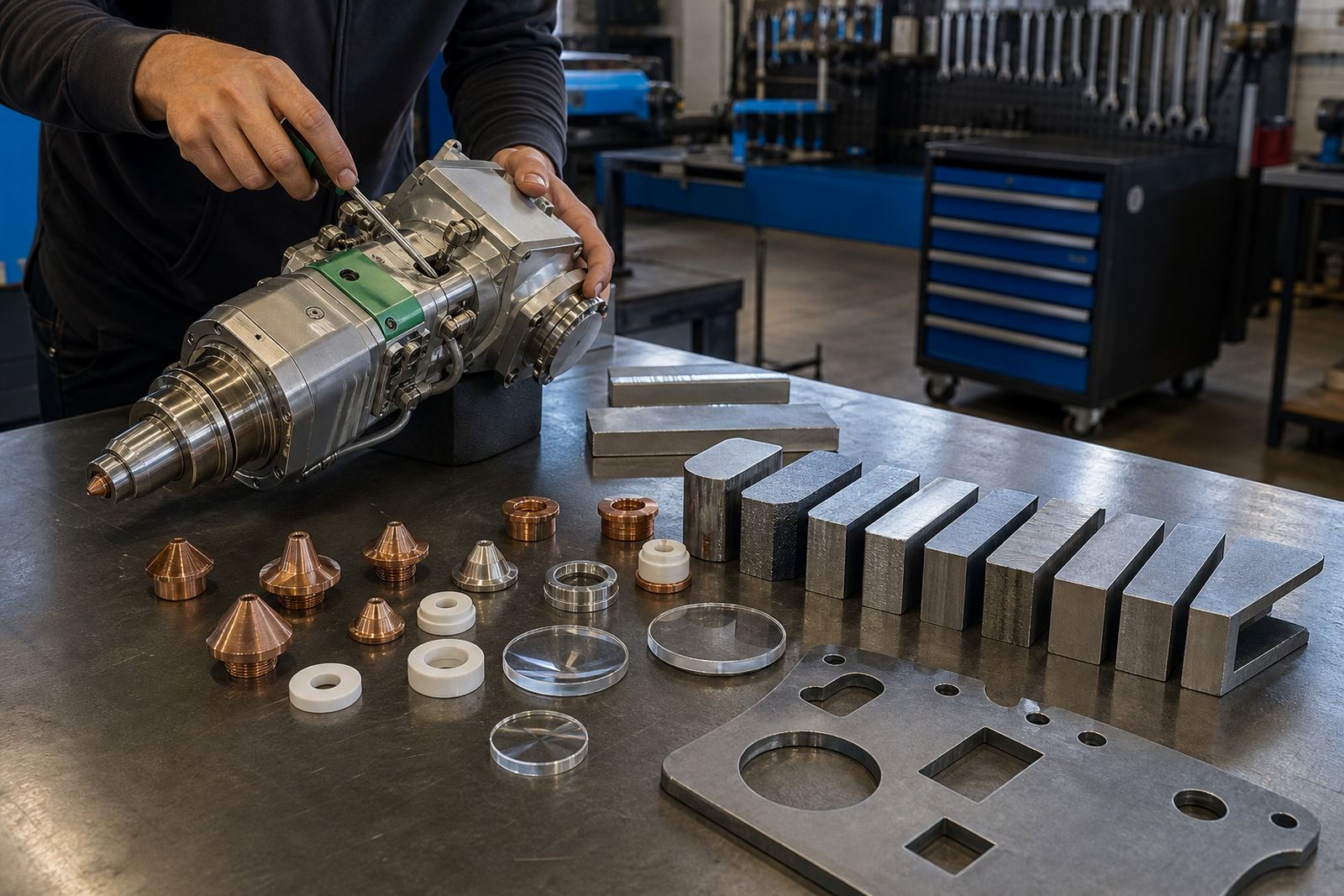
The head was bench serviced, the optical path cleaned, the ceramic ring renewed and the capacitive sensor checked before alignment was set again. Once the nozzle and focus were back in line, the cut stabilised and the gas pattern started doing its job properly. The key lesson was plain: thick sheet exposes the small faults first, and it does not take many of them to spoil a long run.
That sort of work is common across Rustenburg, Cape Town and the East Rand too, especially where shops move between light gauge panels and heavier production plate in the same week.
What the head needs before thick-sheet production
Before a long run on heavy material, the head should be treated as a working assembly rather than a sealed box. Check the nozzle, lens stack, ceramic ring, seal condition and gas path together. If one part is tired, the others often carry the strain and the job gets harder to hold consistently.
Bench servicing is useful when the head needs full attention, while on-site alignment helps when the machine is installed and the problem sits in line-up rather than in a damaged part. Spare head preparation also makes sense for shops that cannot afford to stop every time a crash leaves the head out of shape. The practical aim is to keep thick-sheet work steady, predictable and free of avoidable guesswork.
For shops cutting across Johannesburg, Pretoria, Durban, Cape Town, Rustenburg and nearby industrial areas, thick plate calls for careful setup. Focus, gas and optical condition have to work together, and if one of them slips the cut tells you very quickly.