A Spartan workshop with edge marks and drifting focus
The job came from a sheet-metal shop in Spartan, Kempton Park, working on daily plate cutting for brackets, covers and folded parts. Their cutting head had been running with poor edge quality, the pierce points were inconsistent and the operator could see heat marks where the beam was not staying as clean as it should.
The brief was practical. They needed bench strip work, a new protective window, nozzle centring and a focus check that would suit mixed mild steel jobs. The machine was still in production, so the workshop wanted the cutting head handled carefully and returned with a proper check on seals, ceramic ring condition and gas path cleanliness.
- Client type: local fabrication workshop
- Area: Spartan, Kempton Park
- Machine issue: rough edges, drift in focus and unstable cutting conditions
- Work needed: bench service, window replacement, nozzle centring and inspection
Bench strip work, without skipping the small parts
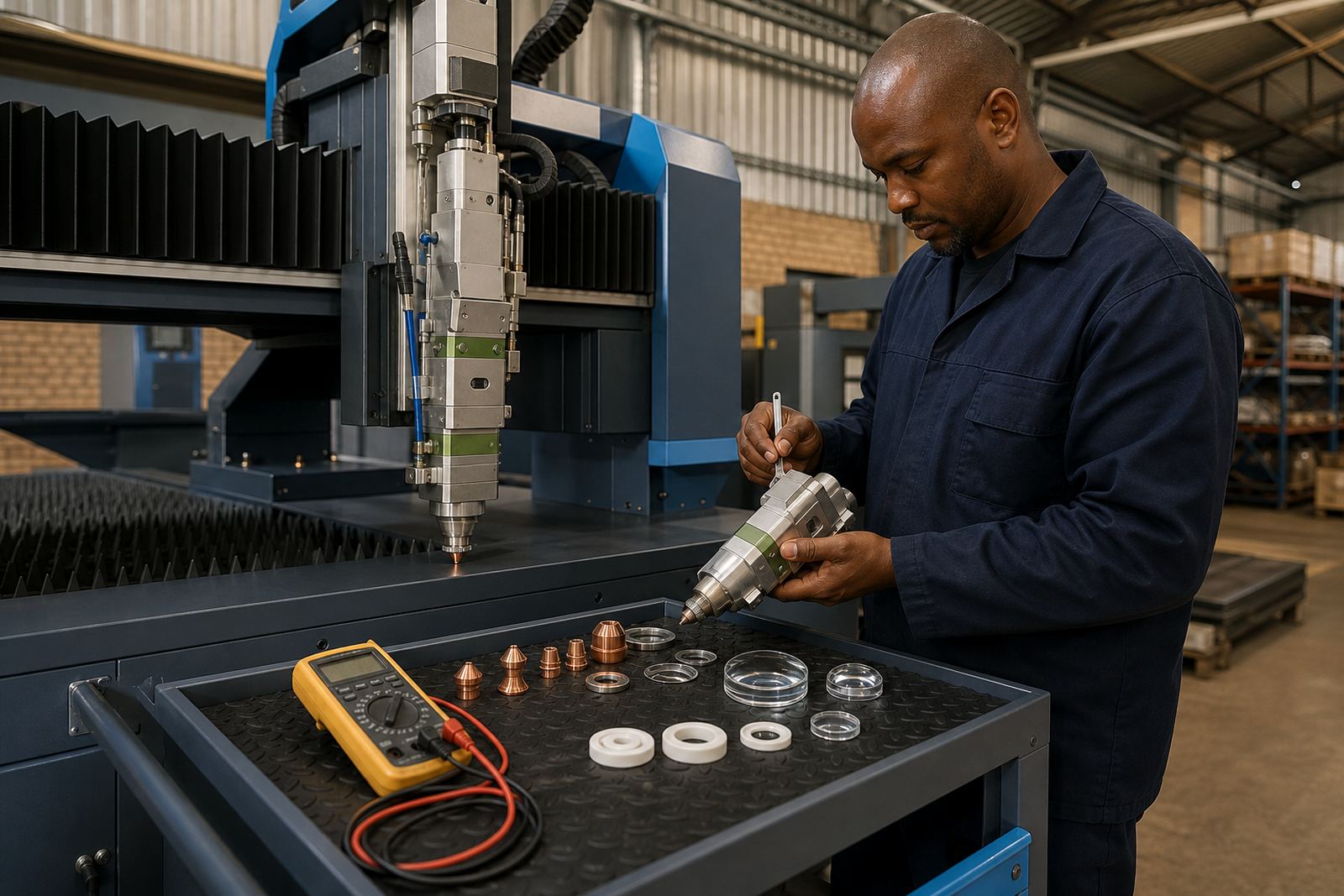
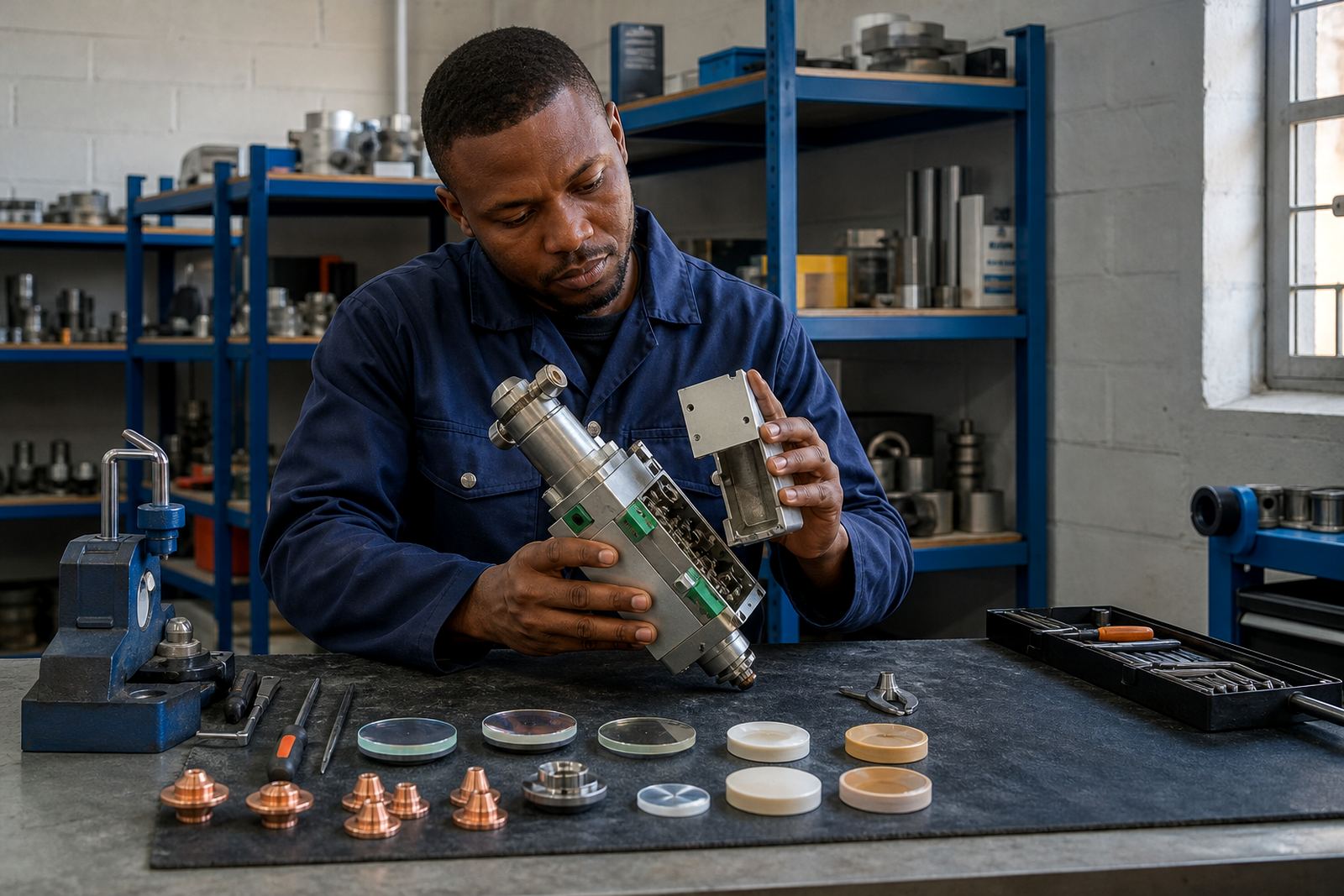
On the bench we opened the cutting head, cleaned the visible carbon and dust from the internal passages, then checked the lens seat, ceramic ring and seal surfaces. The protective window had heat stain and fine contamination, so it was replaced before the head was closed up again. Where a head has been running in a busy workshop, those small marks matter more than people expect.
We also checked the focus lens and collimator lens for contamination and edge damage, then set the optical stack back with care. Nozzle centring was done against the beam path, not by eye alone, because a small offset can show up as wider kerf, dross and poor pierce behaviour on thinner sheets. The head was then prepared for alignment on the machine side.
- Protective window replacement completed
- Lens cleaning and visual inspection carried out
- Nozzle centring checked against beam position
- Head seals and ceramic ring inspected for wear
Setting the head so the cut could settle down
The workshop also asked us to look at capacitive height sensing and the focus setting, because both had become unreliable during changeovers. We checked the sensor behaviour against the sheet surface, then verified that the head was tracking at a steady standoff during motion. That matters on cut parts with corners, cut-outs and pierce points, especially when the material thickness changes through the week.
Focus setting was reset to suit the material profile they were running, with a second pass for the parts that showed the most heat build-up. We do not chase one magic setting for every sheet, because the cut path, gas choice and thickness all change the result. The workshop needed something their operators could use day to day, not a fancy note that only works once.
- Capacitive sensor check completed
- Focus setting verified and adjusted
- Gas path inspected for dirt and restriction
- Clean sheet contact points checked for stable tracking
On-site alignment where the machine sat in the bay
After the bench work, Lerato handled the on-site head alignment at the workshop in Spartan. The machine had enough room for testing, but the bay was tight and the table had fresh offcuts under it, so the alignment work had to be done with care and a fair bit of crawling around the frame. The point was to line up the head in the real working position, not in a quiet corner that tells half the story.
The alignment covered the beam path, head angle and the way the nozzle behaved during motion over a full sheet area. We checked the machine at the edge of the plate and through the centre, then watched the cut quality on test pieces before signing off the setup. That part of the work makes the bench service count, because a clean head still needs the machine side to sit true.
- On-site head alignment completed
- Head angle checked across the sheet area
- Test cuts reviewed on the machine
- Final setup confirmed at the workshop bay
A two week job with a cleaner cut path
The full job ran over two weeks from collection, bench service, parts fitment and on-site alignment. The workshop could keep planning around the machine because the work was broken into sensible steps instead of forcing everything into one rushed visit. That gave us time to check the small details, including the ceramic ring, nozzle seat and protective window holder.
By the end of the job the cutting head was running with steadier pierces, less edge flare and a more even cut on the thinner sheet. The operator also had a clearer cleaning routine to follow, especially around the window and nozzle area where dust and fine spatter tend to build up. A clean head does not stay clean by accident, it needs regular attention.
- Timeline: two weeks
- Result: steadier pierces and cleaner edges
- Result: less flare on thin sheet cutting
- Result: clearer cleaning routine for operators
What we would carry into the next head service
If we had to do a similar job again, we would still begin with bench stripping before touching the machine side. That order gives the clearest picture of what is worn, what is dirty and what only needs resetting. We would also keep the nozzle centring and focus check together, because one without the other can leave the cut looking half fixed.
For Spartan fabrication shops, the main lesson is to treat the cutting head as a working part, not just a consumable holder. Protective windows, focus lenses, collimator lenses and ceramic rings all earn their keep, and when one of them starts to drift the cut shows it fast. We prefer to catch that drift before it turns into scrap, rework or a head that needs heavier repair than it should.
- Start with bench inspection and strip-down
- Replace contaminated windows before deeper faults grow
- Check focus and nozzle centring together
- Keep cleaning routines short and regular