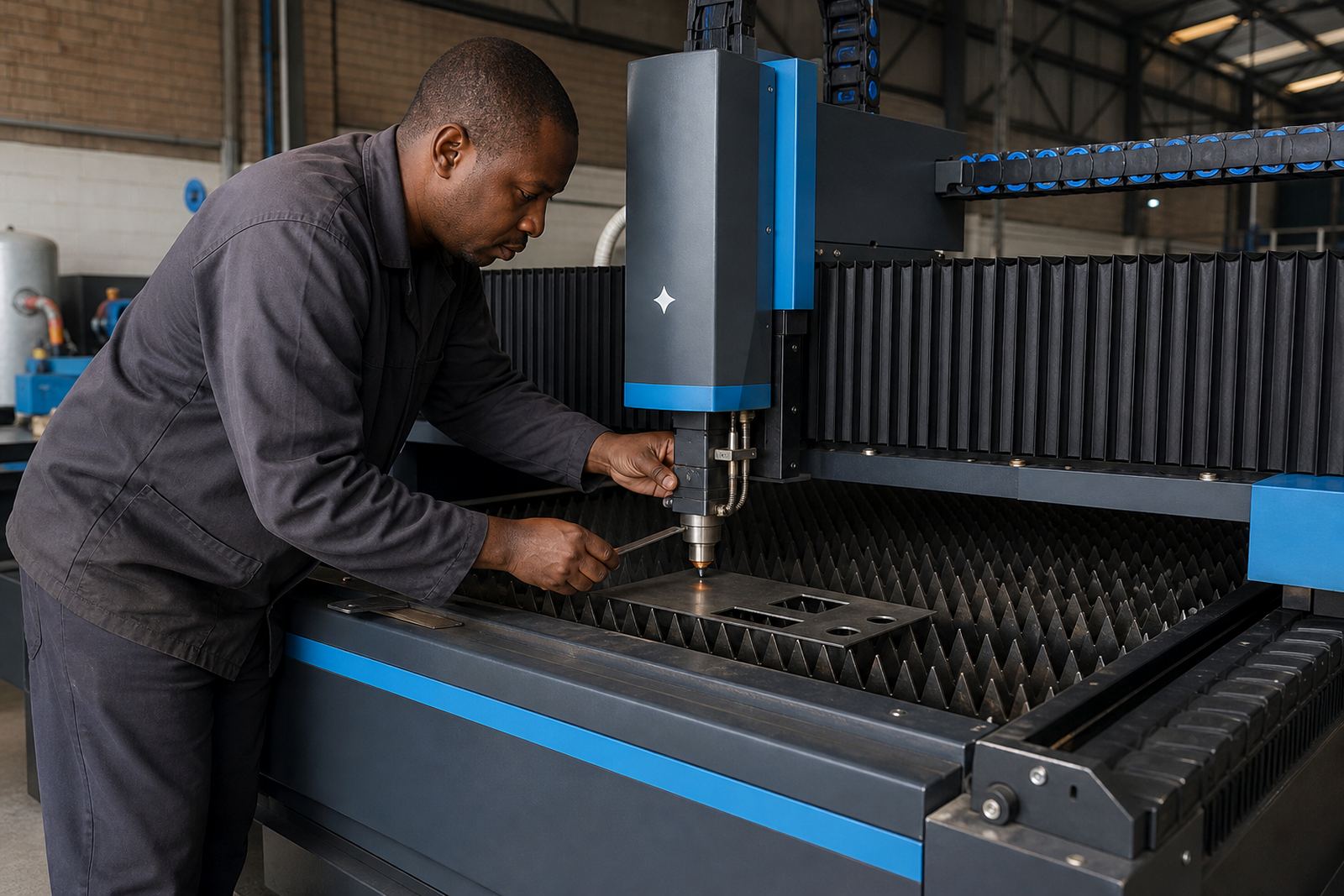


What the Boksburg team was seeing at the machine
The shop was running fibre laser cutting on mixed sheet thicknesses, with daily output moving between nested panels and smaller repeat jobs. The operators could see unstable piercing on some parts, a narrow kerf that changed from one shift to the next, and a drop in cut consistency after the head had been in service for a while.
They asked for a protective window contamination diagnosis first, not a full rebuild. The machine was still cutting, but the signs pointed to residue on the window, dust tracking around the ceramic ring, and a need to check the focus position before the problem spread into the lenses.
- Client type: sheet-metal cutting shop
- Town: Boksburg
- Primary issue: protective window contamination and cleaning control
- Machine area: cutting head, nozzle stack and sensor zone
The brief had to suit an active production floor
We were asked to keep the visit practical, with as little interruption as possible to the cutting programme. The head needed inspection, the consumables needed sorting, and the production staff wanted a routine they could follow without turning every shift into a service session.
The constraints were ordinary for a busy shop. Parts had to stay traceable, the head could not be handled roughly, and the cleaning steps had to make sense to people working close to dust, spatter and mild oil film. The team also wanted clear signs for when a protective window should be replaced, rather than kept in service past the point of recovery.
- Keep interruption low on the shop floor
- Check contamination without disturbing alignment
- Set a repeatable cleaning sequence for staff
- Identify wear on ceramic rings, nozzles and sealing points
Bench work on the head and optics
We removed the head for bench inspection and worked through the parts in order. The protective window showed contamination that had not been wiped correctly, and the nozzle seat carried residue that would have affected gas flow. The focus and collimator lenses were checked for marks, and the ceramic ring was examined for cracks and heat wear.
The cleaning was done in a controlled way, using the right cloths and handling steps for optical parts. We also checked the capacitive height sensing path, because a dirty or drifting sensor zone can make the head read the sheet poorly and throw off the cutting distance. The focus setting was then reviewed against the machine behaviour the operators had described.
- Protective window contamination cleaned and assessed
- Nozzle centring checked for alignment and wear
- Focus lens and collimator lens inspected
- Capacitive sensor zone checked for dust and residue
- Ceramic ring condition recorded for replacement planning
Field alignment and the cutting edge of the job
After the bench service, we went back to the machine for on-site head alignment and a final working check. That let us confirm the nozzle position, the focus point, and the distance control while the head was mounted in its normal working position. On fibre laser cutting systems, a head may seem sound on the bench, then drift once it is back under production vibration and daily handling.
We also carried out a gas path inspection and looked for any simple cause of poor edge finish that would be easy to miss in a busy shop. A small air leak, a worn seal or a dirty nozzle seat can make cut quality wander, especially when the team is changing jobs quickly. The crew watched the sequence and took notes for their own daily checks.
Cleaning routine handover for the production staff
The handover was aimed at the people nearest the machine, not just the maintenance lead. We set out a routine that covered safe checking of the protective window, the order for cleaning the nozzle and sensor area, and the signs that mean the head should be stopped and inspected before more sheets are cut.
The staff also asked about the difference between single layer and double layer nozzles, and when each one changes the gas behaviour at the cut face. We covered that point in plain terms, along with how small focus shifts show up in edge finish and piercing. The result was a cleaner, more repeatable process for the people loading the machine every day.
- Cleaning order for window, nozzle and surrounding seat
- Visual marks that suggest lens or seal trouble
- Basic check points for focus setting drift
- When to stop and call for inspection rather than keep cutting
What changed after the service visit
The shop left with a clear diagnostic trail and a cleaner optical path. The worst contamination had been removed, the head alignment was restored to line, and the team could see how dust control and handling habits affected the cutting head. Their operators were also better able to judge when a nozzle issue was causing a cut problem, rather than blaming the sheet or the program straight away.
For a Boksburg production floor, that matters because the work often moves fast and the same head may be used across several job types in a day. A clean window, a sound ceramic ring and the right focus setting do not sound dramatic, but they keep the cut more predictable and reduce the guesswork between shifts.
- Cleaner protective window and better optical clarity
- More stable cut behaviour after focus and alignment checks
- Clearer staff routine for daily inspection
- Better separation between consumable wear and machine fault
What we would repeat on a similar laser cutting head service job
On a similar shop floor, we would still start with the protective window and the nozzle seat before moving deeper into the head. That order tells you a lot very quickly, and it avoids replacing parts that only look guilty because they sit near the dirty section. We would also repeat the staff handover, because the machine is only as steady as the cleaning routine around it.
For a cutting shop that runs fibre laser work in Johannesburg, Pretoria or the East Rand, the same approach holds. Check the visible contamination, verify the focus setting, inspect the ceramic ring, then confirm the sensor zone and gas path. It is plain work, but it saves confusion when the cut edge starts changing and everybody wants a single answer.
- Start with the window, nozzle and seat
- Confirm focus before changing larger parts
- Leave staff with a clear cleaning sequence
- Use the head alignment check to close the loop
Key facts
| Project | Protective window contamination diagnosis and cleaning routine handover |
|---|---|
| Client type | Boksburg sheet-metal cutting shop |
| Scope | Bench head service and on-site head alignment |
| Parts checked | Nozzles, focus lens, collimator lens, protective window, ceramic ring |
| Control checks | Capacitive height sensing, focus setting, gas path inspection |
| Coverage | Boksburg with support for Gauteng production shops |