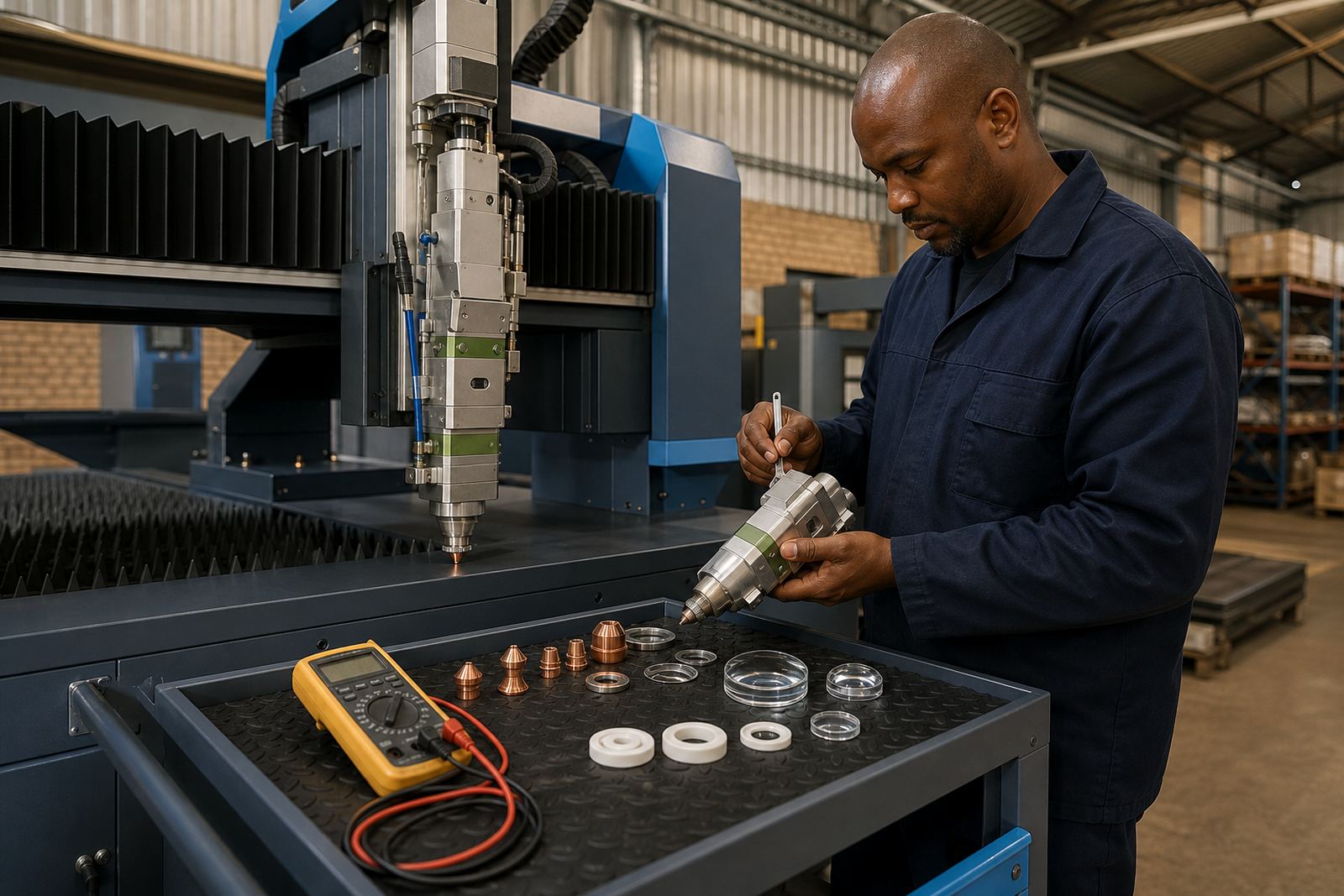
What the Pinetown team saw at the machine
The shop was cutting mild steel and stainless sheet in Pinetown, with the fault showing up after routine cleaning and a few rough cuts. Lower window marks kept returning, edges looked less even on tighter profiles, and the operator could hear the head working harder when pierce settings were not quite right.
We treated it as a contamination and alignment problem first, not a parts-only job. Spatter carry-over from the nozzle area can move debris into the optical path, and once a protective window starts taking that abuse the marks usually show in the same place. The client needed the line kept usable while the head was checked in sections, so the work had to balance bench testing with a return visit on site.
- Location: Pinetown, KwaZulu-Natal
- Machine type: fibre laser cutting head on sheet-metal equipment
- Fault pattern: lower window damage, unstable cutting edge, repeat contamination
- Constraint: keep the cutting line moving around the repair window
Bench checks that showed the fault pattern
The first stage was bench service at our Spartan, Kempton Park shop. We stripped the head down far enough to inspect the ceramic ring, nozzle seat, lens stack and seal faces, then checked the focus and collimator lenses for haze, edge marks and heat staining. A clean lens can still be wrong in practice if the seating is off, so the alignment marks and contact faces mattered as much as the glass itself.
We also checked the capacitive height sensing path. If that circuit reads poorly or drifts, the head can sit at the wrong distance during pierce and then the nozzle ends up close to the sheet when it should not be. That is when spatter gets invited back into the lower section, and the protective window takes the first hit.
The job called for a careful cleaning routine rather than aggressive wiping. We cleaned the optical compartments, replaced the worn consumables that were no longer holding concentricity, and checked the nozzle centring with both single layer and double layer nozzle options in mind. The cut mix on this job meant the nozzle condition had to support both pierce stability and gas flow, not just one of them.
- Focus lens condition checked under light and magnification
- Collimator lens seating verified for dirt lines and movement
- Protective window inspected for lower arc marks
- Ceramic ring replaced where the contact surface had worn
- Nozzle centring reset before the head left the bench
Field alignment once the machine was back in service
After the bench work, Lerato handled the on-site head alignment in Pinetown. That point matters because a laser head may appear fine on the bench yet still sit slightly out once fitted into the machine frame. We checked the cut face, adjusted the working focus setting against the sheet conditions, and ran a fresh nozzle centring pass so the beam sat properly through the gas path.
The alignment work also included a head seal rebuild check and a careful look at the sensor reading over a few practical test cuts. The machine was producing parts where small errors showed quickly, so we used simple trial sections to see whether the dross, edge heat and start point marks were settling. Nothing fancy, just enough to confirm the head was tracking the sheet in a stable way.
Because the lower window damage had started with a poor cleaning sequence, we spent time on the handling order too. Lens cleaning came before final assembly, spatter was cleared from the nozzle area before the next run, and the protective window was fitted only after the housing had been cleaned and checked for residue. That sequence sounds basic, but it is where many repeated faults begin.
What the job changed on the floor
The immediate result was cleaner cutting and far less drama around the lower window area. The cut edges settled down, the head no longer showed the same pattern of repeat contamination, and the operator had a better feel for when focus drift or nozzle wear was starting to show. The client also had a spare head prepared, so there was a fallback ready if the line needed it later.
For a Pinetown fab shop, that kind of fix is not about one part only. It is about keeping the optics clean, matching the nozzle to the work, and making sure the height sensing and focus setting are not working against each other. Once those pieces line up, the machine stops wasting windows and starts producing steadier edges.
- Lower window damage pattern stopped repeating on the same section
- Cut quality improved on common sheet sizes and thinner material runs
- Consumable wear became easier to track during normal checks
- The team had a cleaner routine for nozzle and lens handling
The consumables and checks that mattered most
On this project, the useful parts were not the flashy ones. They were the consumables that keep a cutting head honest from one shift to the next. A nozzle that is slightly out, a ceramic ring with a tired seat, or a protective window with a faint mark can all push a fibre head into unstable behaviour before anyone notices it on the first parts.
We kept the focus on these practical items:
- Single layer nozzles for cleaner gas flow on standard cutting runs
- Double layer nozzles where the process needed a steadier pierce path
- Focus and collimator lenses checked for clarity and seating
- Protective windows changed before the lower section took more damage
- Ceramic rings replaced where the contact face had worn unevenly
- Capacitive sensor check to confirm the head sat at the right height
Those parts do not work in isolation. A clean window cannot fix a bad nozzle, and a fresh nozzle will not help if the focus setting is drifting. The job was successful because the full chain was checked, not just the visible damage.
What we would repeat on a Pinetown job of the same kind
We would work through the same steps on another head with those same symptoms. Start with bench service, inspect the optical path from collimator to protective window, reset nozzle centring, and only then move into on-site alignment. That order keeps the checks tied to the real fault rather than guessing at one worn part.
On a head like this we would also set a simple, strict cleaning routine. Remove spatter before it reaches the window, check the ceramic ring before the next long run, and watch for small focus changes when the sheet thickness changes. That approach is steady, practical and far cheaper than chasing the same lower window damage every few weeks.
For sheet-metal shops in Pinetown and across South Africa, our contact form is the way the team sends through the machine details, the fault pattern and the parts list needed for the job. Once the basics are on hand, the repair path stays clear and the head work can be matched to the machine instead of forcing the other way round.
Key facts
| Project | Pinetown Fab Shop |
|---|---|
| Town | Pinetown, KwaZulu-Natal |
| Service mix | Bench Head Service and On-site Head Alignment |
| Fault focus | Lower window damage from cleaning sequence and spatter carry-over |
| Timeline | 2 weeks |
| Machine scope | Fibre laser cutting head on sheet-metal equipment |