
Weekend cut list, one machine, no room for drift
The brief came from a Midrand sheet-metal contract shop working on mixed plate and sheet jobs for local fabrication work. Their laser cutter was still producing parts, but the cut edge had started to vary and the crew could see heat marks, a wider kerf on some nests and occasional pierce hesitation. They wanted the cutting head cleaned, checked and reset before the weekend run, with no long strip-down that would hold the machine out of service.
The machine was running fibre cutting work with a standard gas-assisted process and a capacitive height sensing head. The optics stack needed a proper clean, the nozzle stack had to be checked for centring, and the focus setting needed to be verified against the material mix on their job sheet. The room was tight too, so the work had to fit around the shop's own staging area and the operator's cut plan.
- Client type: contract sheet-metal shop
- Town: Midrand
- Scope: optics clean, process reset and head alignment
- Timing: completed over one week, with bench work before the on-site check
What we carried to the bench and what stayed on the machine
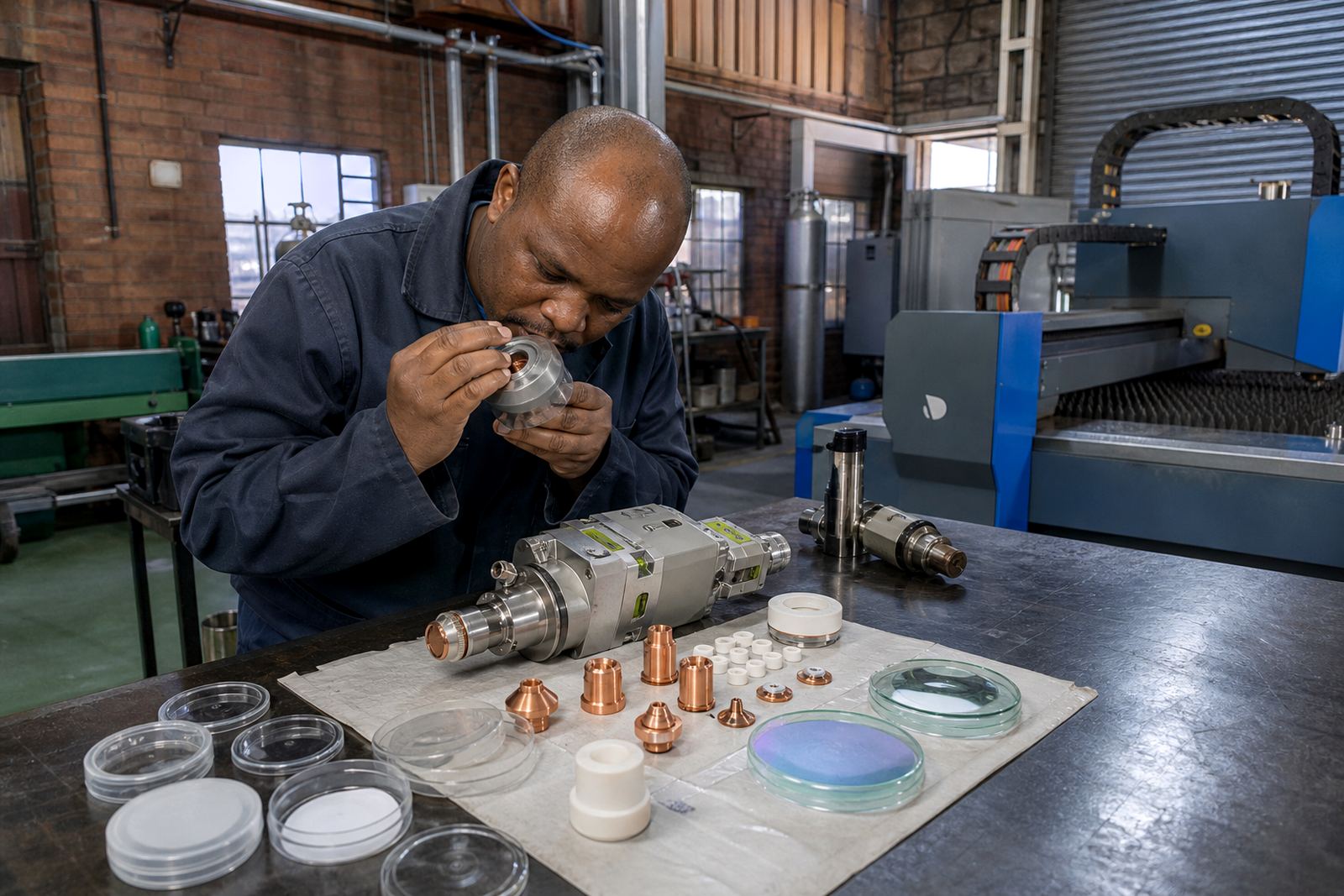
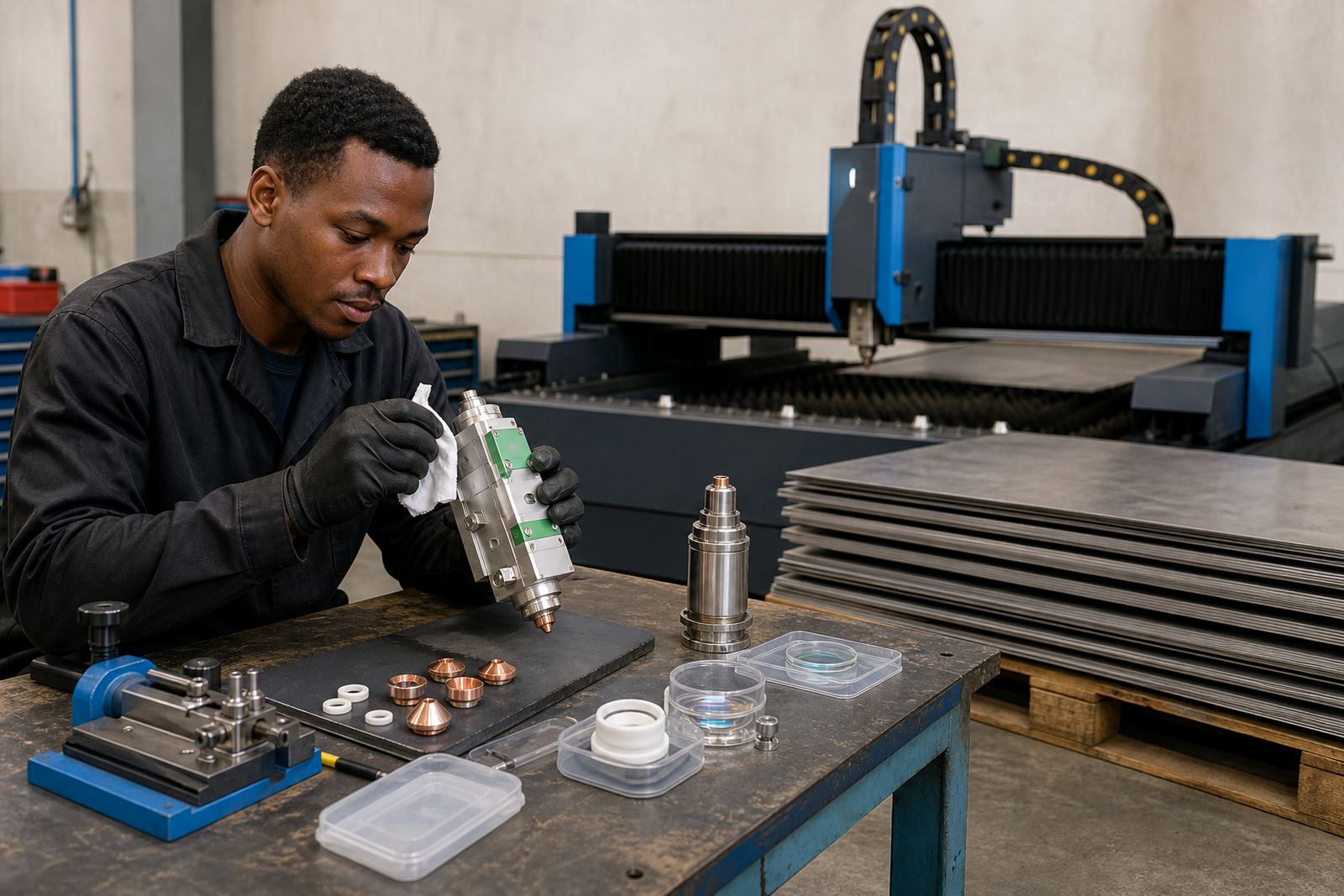
We removed the cutting head assembly for bench service and kept the machine-side work to the checks that had to happen in place. That let us inspect the nozzle seat, the ceramic ring, the protective window condition and the lens stack without rushing the finer parts of the set-up. The protective window had light contamination rather than a full fracture, so it could be replaced as a precaution before the weekend load.
On the bench we cleaned the focus lens and collimator lens, checked the seal path and rebuilt the head body where the dust pattern showed leakage around the front end. The nozzle bore had small burr marks from handling, which can throw gas flow off by enough to spoil a neat edge on thinner material. A bent or scuffed nozzle also upsets centring, so we treated that as part of the job and not as an afterthought.
- Bench service on the cutting head body
- Protective window replacement
- Focus lens and collimator lens cleaning
- Head seal rebuild and gas path inspection
Nozzle centring, sensor check and focus set to the material mix
Once the head was back in place, the field alignment work started. We checked nozzle centring against the beam path and verified the capacitive height sensing so the head could keep a stable standoff over the sheet. The shop was cutting both thinner stock and heavier plate in the same run, so the focus setting had to be practical for the full batch rather than perfect for only one test piece.
The cleaning routine mattered as much as the parts swap. Residue on the window or a smear on the lens will show up quickly in a cutting head, especially where assist gas and fine dust sit in the same cabinet. We cleared the internal surfaces, confirmed the seating of the ceramic ring and checked the head for any sign of crash damage around the front face. No major structural damage showed up, but the front end did need careful re-seat and measurement.
- Nozzle centring set for the installed cutting head
- Capacitive sensor checked and stabilised
- Focus setting checked against mixed gauge material
- Front face inspected for crash marks and seal wear
Job constraints on a Midrand floor are never neat
The shop did not want extra downtime, and they could not spare a long machine strip because the contract stack was already staged. That meant the work had to be split into practical steps: bench service first, then a short on-site alignment and a final operator handover. The space around the machine was also busy with offcuts, sheet trolleys and packaging, so access was tighter than a clean showroom job.
There was another pressure point. The crew needed the machine to cut cleanly without chasing settings every few sheets, because that burns time and causes avoidable scrap. We kept the focus notes plain and the cleaning routine simple enough for the operators to repeat between production blocks. A head that is clean but not centred still gives uneven results, so the alignment and the optics work had to be done as one package.
- Tight floor space around the machine
- Short service window before the weekend run
- Mixed material gauges in one batch
- Need for stable cut quality without repeated adjustment
The result on the first proper cutting run
After the reset, the machine returned to a more even cut pattern and the pierce behaviour settled. The operator reported less variation between nests, fewer edge marks on the lighter sheet and a steadier response from the height sensing during longer runs. That is usually what a clean optics stack and a correct nozzle seat should give you, not a dramatic miracle, just a machine that behaves the way the job card says it should.
The protective window change mattered here as well, because a dirty window can make the head feel unstable even when the mechanics are sound. With the lens stack cleaned, the nozzle centred and the head resealed, the shop could go into the weekend batch with a cleaner process. The parts were not exotic, just the right parts in the right order and checked properly.
- More even edge quality across the batch
- Cleaner pierce behaviour on the first run
- Steadier height sensing on mixed gauges
- Less time lost to repeated setting changes
What we would carry over on a contract job like this
For a job like this, the best sequence is still the same: bench service first, then field alignment, then a focused cut test with the actual material mix. The head should not be treated as a loose spare part when the real issue may sit in the window, the ceramic ring, the gas path or the focus setting. Put all of those together and the machine has a fair chance of running cleanly for the next production block.
We would also keep the cleaning routine short and practical for the operators. Wiping the wrong surface, over-handling a lens or leaving dust in the seating face can undo the service work in a hurry. The Midrand crew had a busy floor and a hard deadline, so the job had to be plain, careful and complete.
- Do bench service before field alignment
- Check the nozzle, window and lens stack as one system
- Match the focus setting to the live material mix
- Leave the operators with a usable cleaning routine
Key facts
| Project | Midrand contract shop optics clean and process reset |
|---|---|
| Town | Midrand |
| Machine scope | Fibre laser cutting head service and alignment |
| Parts handled | Nozzles, focus lens, collimator lens, protective window, ceramic ring |
| Services used | Bench Head Service, On-site Head Alignment, Nozzle Centring, Focus Setting Check, Capacitive Sensor Check |
| Coverage | Gauteng, Rustenburg, the East Rand, Durban and Cape Town and surrounding routes |