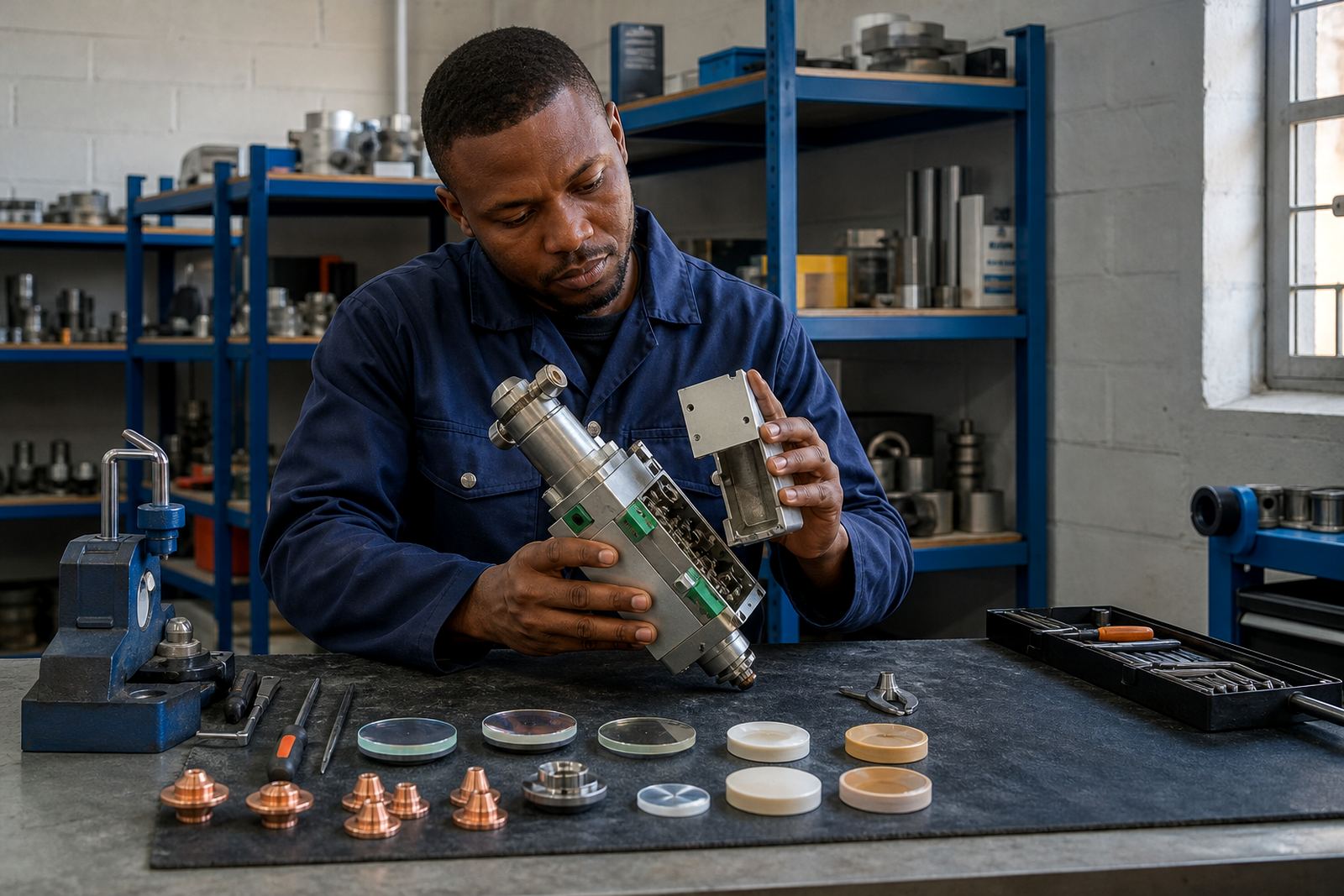
Germiston panel work and the cut quality problem
The job came from an enclosure shop in Germiston that runs panel parts for electrical and general sheet-metal assemblies. Their cutting team had one line where edge finish was changing from run to run, with small burrs showing up more often on narrower parts and on longer nesting sheets.
The brief was straightforward in shop terms. Check the fibre laser head, verify the focus position, inspect the ceramic ring, and sort out anything that could upset nozzle centring or the capacitive sensing signal. The machine was still running, but the operator had started to compensate at the control screen and that is usually where trouble spreads.
- Town: Germiston, East Rand
- Material type: sheet-metal enclosure parts
- Primary issue: focus drift and worn ceramic ring
What we found at the head and around the nozzle seat
On inspection, the head showed the kind of wear that comes from regular cutting in a busy shop, with contamination around the nozzle area and a ceramic ring that had lost its clean seat. That does not always stop production, but it can make the cut unstable and the height sense less consistent when the sheet surface varies or when dust builds up around the head.
We checked the protective window condition, lens cleanliness, and the general alignment of the cutting stack. The focus setting was not wildly off, yet it was not sitting where the shop wanted it for their common material thicknesses. The nozzle centring also needed attention before the line could be trusted for cleaner repeat work.
- Focus setting check carried out on the bench
- Ceramic ring replaced with a fresh part
- Nozzle seat and gas path inspected for contamination
Bench service before the head went back on line
Back at the bench in Spartan, we stripped the head to the working level needed for inspection, cleaned the contact points, and checked the condition of the focus and collimator lenses. The protective window was handled carefully and set aside only if there was evidence of marking, because a light haze can still affect cut quality on reflective or thin material.
The nozzle was centred and the head seals were checked so that the customer would not carry a hidden leak or a loose fit back into production. We also checked the capacitive height sensing path, because when that signal is lazy or noisy the operator ends up chasing the cut instead of running it. That sort of chase costs time and sheet offcuts.
- Bench Head Service completed in Spartan, Kempton Park
- Lens cleaning and inspection performed
- Head seal rebuild checked against wear points
On-site alignment and settings work on the cutting line
Once the serviced head was ready, we moved to the Germiston line for on-site head alignment. The machine side needed a practical check under real cutting conditions, not just a clean bench test. We aligned the head, confirmed nozzle centring on the machine, and rechecked the focus position against the sheet type the shop uses most often.
We also ran through the cleaning routine with the operators, including how to keep dust off the nozzle face and how to inspect the ceramic ring before a shift gets busy. In a shop that cuts enclosure panels, small contamination points build up fast and they tend to show on corners, slots, and tight internal shapes first.
- On-site Head Alignment completed in Germiston
- Capacitive Sensor Check performed on the machine
- Focus and nozzle settings confirmed under working conditions
Turnaround measured in weeks, not guesswork
Our team carried out the job in stages across two weeks. The first stage was inspection and bench service in Spartan. The second stage was the site visit for alignment, confirmation of the sensing path, and a final look at the cut behaviour on the enclosure line. That split kept the work tidy and let the shop stay organised around its own production schedule.
For a line like this, the real measure is not talk, it is whether the edge finish settles down and the operator stops needing small corrections every few sheets. After the service, the cut became steadier and the head ran with less drift between checks. The shop could hold its usual settings with less fiddling at the panel edge.
- Stage 1: bench inspection and parts replacement
- Stage 2: site alignment and machine-side checks
- Result: steadier cutting and cleaner panel edges
What we carry forward into the next enclosure line
If we were doing a similar Germiston enclosure line again, we would start with the focus setting, nozzle centring, and ceramic ring condition before looking at anything more complicated. Those three points usually tell the story early. If the head is clean, the sensor path is stable, and the lenses are in proper condition, the rest of the tuning is much easier to hold.
We would also keep an eye on the cleaning routine the shop uses between shifts. A good routine does not need fancy language, just steady hands, the right cloths, and no rushing around the nozzle seat or protective window. That keeps the head working as a tool, not as a mystery.
- Start with focus, centring, and ring condition
- Keep cleaning routines plain and regular
- Check the sensing path when cut quality starts to drift
Key facts
| Project | Germiston Enclosure Shop |
|---|---|
| Town | Germiston, East Rand |
| Scope | Focus check and ceramic ring replacement |
| Service mix | Bench Head Service and On-site Head Alignment |
| Parts | Ceramic ring, nozzle checks, lens cleaning, protective window inspection |
| Timeline | 2 weeks |