
What the Cape Town crew was seeing at the edge
The shop was running thin stainless parts for a local fabrication line, with parts coming off the machine but not holding a clean edge across the full sheet. The operator was seeing rough cuts, small burr lines and a few jobs where the kerf opened up as the run went on.
The machine itself was not the issue on its own. The cutting head needed a proper alignment check, the nozzle path had to be inspected, and the focus setting needed to be checked against the material thickness in use. Fine stainless shows small faults quickly, especially where dust, heat and nozzle wear start to stack up.
- Client type: sheet-metal shop handling fine stainless work
- Town: Cape Town
- Issue: uneven edge quality on repeated cutting runs
- Machine area: fibre laser cutting head and consumables path
The brief from the shop floor
The request was straightforward. They wanted the head checked on site, the nozzle condition assessed, the optical path cleaned where needed, and the cutting face aligned back into a tighter working range. There was also a concern that the capacitive height sensing was drifting slightly, which can show up as a poor cut edge before the operator notices anything obvious.
We also looked at the consumables that usually sit around the head in this kind of work. A worn ceramic ring, a dirty protective window or a damaged nozzle can all give a clean-looking machine with poor cutting results underneath. On stainless, that kind of wear shows up fast.
- On-site head alignment
- Focus setting check
- Capacitive sensor check
- Protective window replacement where needed
Bench work before the alignment run
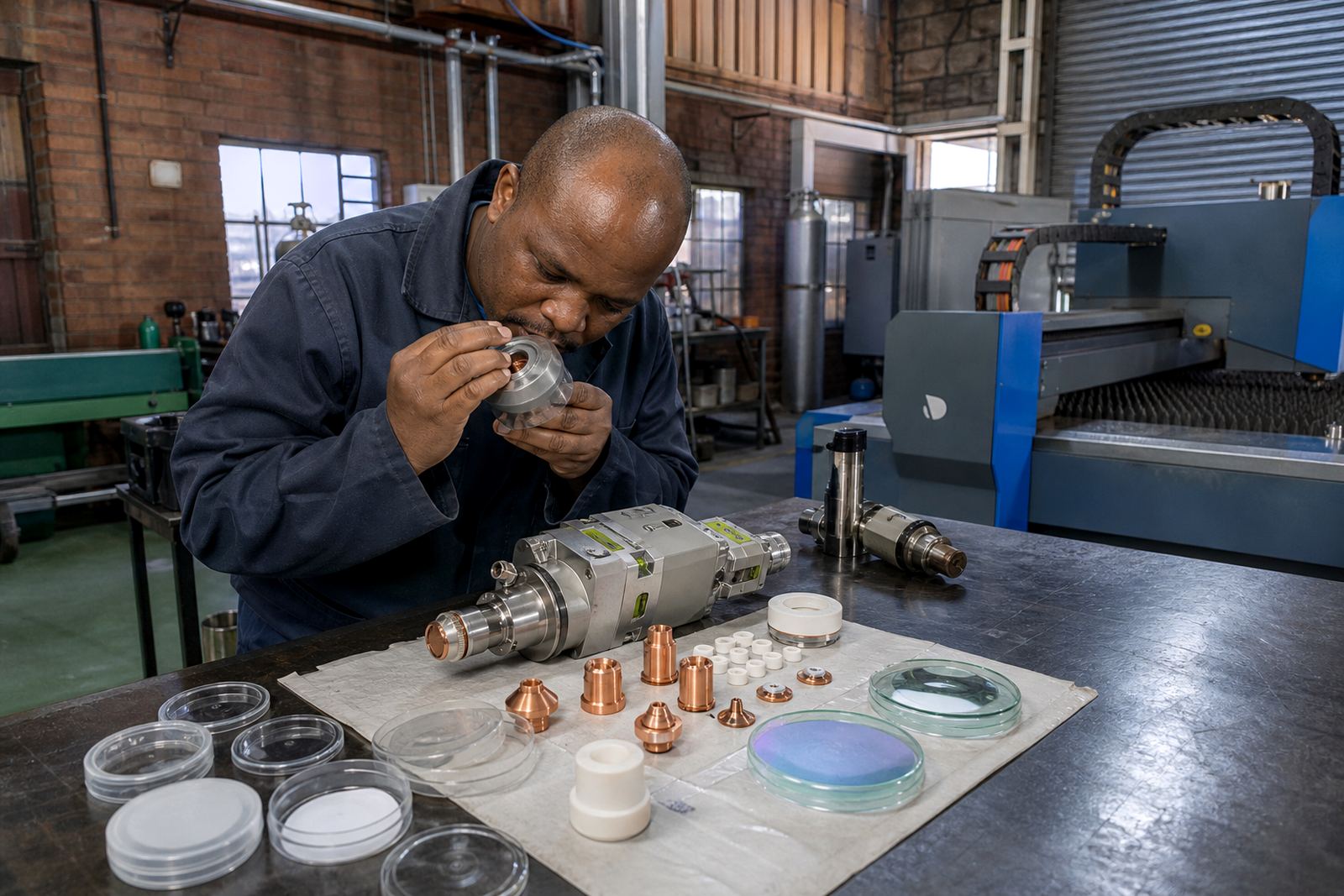
We brought the head into the bench service area first so the main assembly could be checked in a controlled way. The nozzle seat, ceramic ring, lens stack and seal faces were inspected for heat marks, dust and crash scarring. That gave us a proper base before the field alignment work started.
The head was cleaned carefully, then the lens group and protective window were checked for contamination. A dirty window can scatter energy and leave the cut edge looking tired even when the rest of the machine seems fine. We also checked the nozzle options in use, including single layer and double layer nozzles, because a poor match there affects gas flow and edge finish.
- Head bench service
- Lens cleaning and inspection
- Gas path inspection
- Crash damage inspection
Alignment at the machine in Cape Town
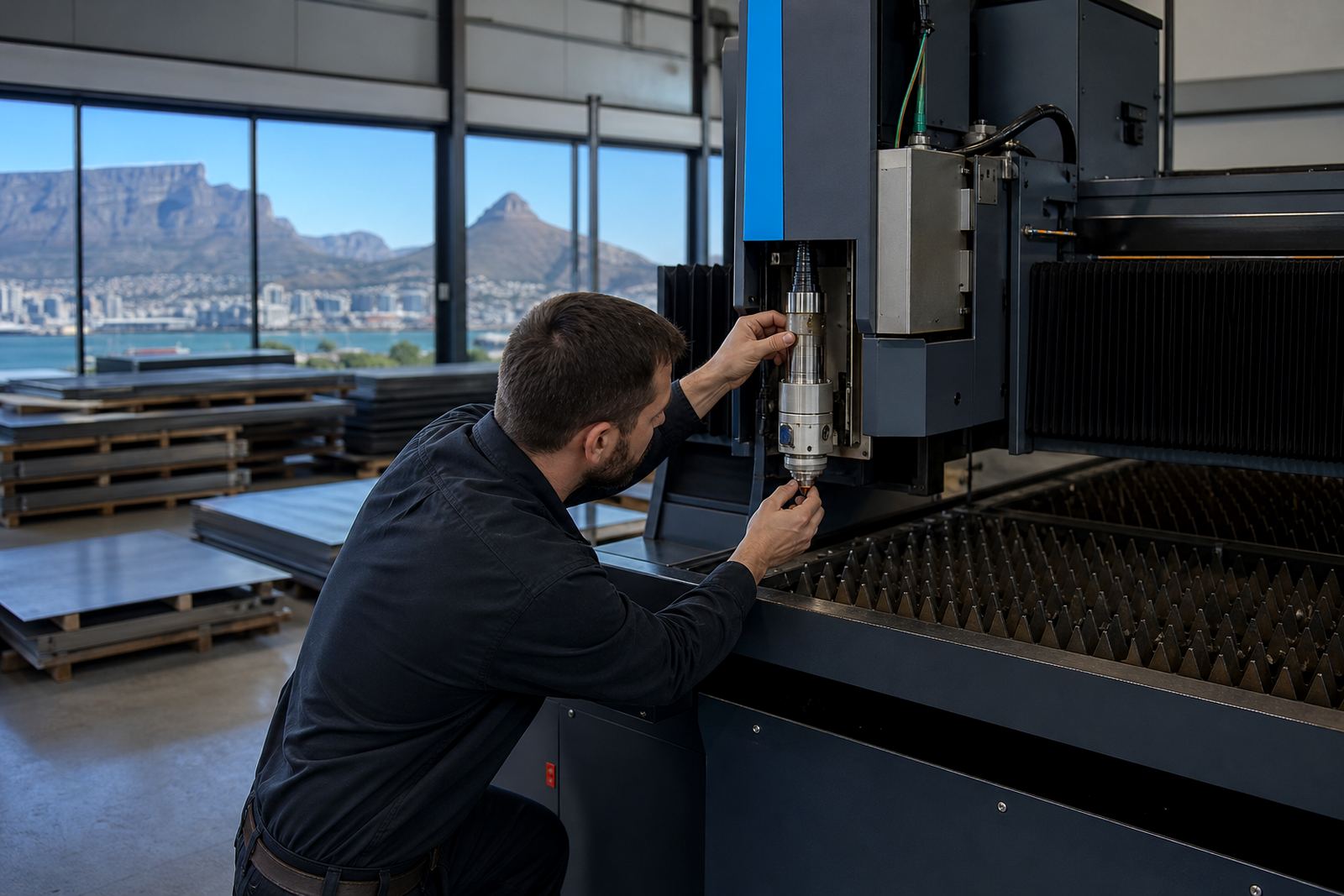
Once the bench checks were done, the head went back on the machine for on-site alignment. We set the cutting head so the beam path, nozzle centre and focus point worked together properly, then checked the cut height sensing response across a test section. That matters on fine stainless, where even a small shift can show up as a streak or a slight flare at the edge.
We kept the work practical and direct. The technician adjusted the head, checked the sensor signal, confirmed the nozzle centring and then watched the cut result on sample sections. The aim was not just a neat setup, but a stable one that the shop could use through a normal production run.
- Nozzle centring
- Focus setting check
- Capacitive height sensing check
- On-site head alignment
What changed on the cut pieces
After the service, the edge quality settled down and the stainless parts were cutting with less chatter at the edge. The burr line reduced and the operator had a clearer baseline to work from on repeat jobs. The shop could also see which consumables needed routine watching, instead of chasing the fault from one part of the machine to another.
That sort of result usually comes from several small corrections rather than one big fix. A clean protective window, a centred nozzle and a proper focus setting make a bigger difference than people expect, especially on thinner sheet where the machine has less room to hide a fault.
- Cleaner edge finish on fine stainless
- Less visible burr at the cut face
- More stable running on repeated parts
- Clearer wear picture for future servicing
What we would repeat on a similar laser cutting head service job
On another Cape Town sheet-metal job like this, we would start with the consumables and the head condition before touching the cut programme. That order saves time and avoids chasing a software setting when the real problem is dirt, wear or a slight shift in the head.
We would also keep the focus check tied to the actual material mix on the floor, not just a generic setting pulled from memory. Fine stainless, mild steel and mixed nesting patterns can all want different attention at the head, and the people running the machine know very quickly when that detail has been missed.
- Check the head first, not last
- Inspect the nozzle and ceramic ring together
- Verify protective window condition before further runs
- Match focus settings to the material in use
Key facts
| Project | Cape Town sheet shop on-site head alignment |
|---|---|
| Work type | Bench head service and on-site head alignment |
| Material focus | Fine stainless sheet |
| Consumables | Nozzles, focus and collimator lenses, protective windows, ceramic rings |
| Checks carried out | Nozzle centring, focus setting, capacitive sensor, gas path, lens cleaning |
| Coverage | Cape Town and the wider South African market, including Johannesburg, Pretoria, Durban and Rustenburg |