Thicker plate, rougher edges, and a head that needed a closer look
The job came from a trailer workshop in Benoni that cuts structural sheet for chassis parts, brackets and repair plates. The team had started seeing rough pierce points, occasional drag marks and a nozzle tip that was not holding a clean centre for long. On thicker material, a small shift in focus or gas flow shows up quickly, so we treated it as a head condition issue rather than a simple consumable swap.
The brief was plain enough: clean the head, inspect for crash wear, check the lens stack, and make sure the sensing side of the head was still behaving properly. The workshop wanted the unit back in usable order without turning the machine into a guessing game, which is fair on a busy trailer floor where a bad cut wastes plate and time.
- Client type: trailer repair and fabrication shop
- Town: Benoni, East Rand
- Work focus: thicker structural sheet cutting
- Main concern: cut quality loss after a suspected head knock
What we stripped, checked and reset on the bench
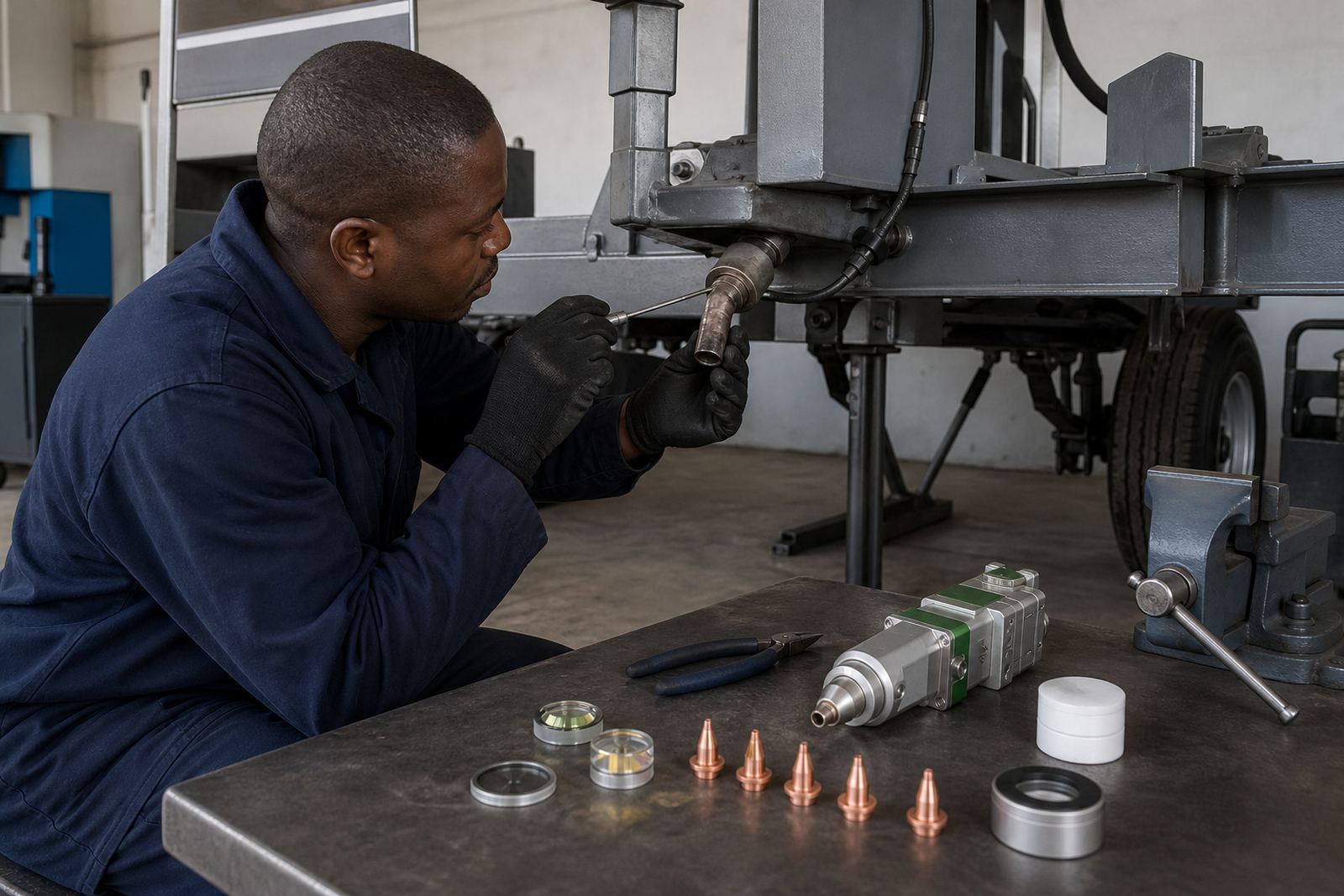
We started with a bench service so the head could be handled under steady light and not under machine pressure. The nozzle seat was checked for wear, the ceramic ring was inspected for chipping, and the protective window was removed to look for heat haze, dust marks and fine pitting. The focus lens and collimator lens were then checked for contamination and alignment, because even a small trace of smoke residue can make the beam behave poorly on heavy plate.
The cleaning routine covered the full working path, not only the visible front end. We cleared dust from the cavities, checked the gas path for blockage and looked over the seal areas where fine metallic dirt tends to collect. The capacitive height sensing parts were also tested, since a head that does not read height cleanly can drift in and out of the cut at the wrong point.
- Nozzle centring checked against the beam path
- Focus setting checked for thick-section cutting
- Protective window replaced where marking was visible
- Ceramic ring replaced where handling damage showed up
- Head seal areas cleaned and reseated
Crash signs on the body, not just on the cut edge
Crashes on a fibre laser head do not always leave one obvious break. Sometimes the signs are small: a scuffed outer body, a loosened thread, a hairline chip around the nozzle area or a sensor surface that reads a touch off centre. We looked for the kind of damage that can make a trailer workshop chase the problem at machine level while the fault sits inside the head.
The inspection included the front assembly, the seating faces and the parts that guide the beam and assist the height control. We also checked for evidence of repeated contact with spatter or plate lift, since structural sheet jobs can throw up hot debris and a slightly warped sheet can nick the head more than once. The point was not only to repair what was damaged, but to stop the same pattern from spreading into the lens stack or sensor path.
- Crash marks noted on the front end and seating face
- Alignment points checked for movement after impact
- Sensor area inspected for dirt and contact wear
- Gas path checked for signs of spatter intrusion
On-site alignment back at the workshop floor
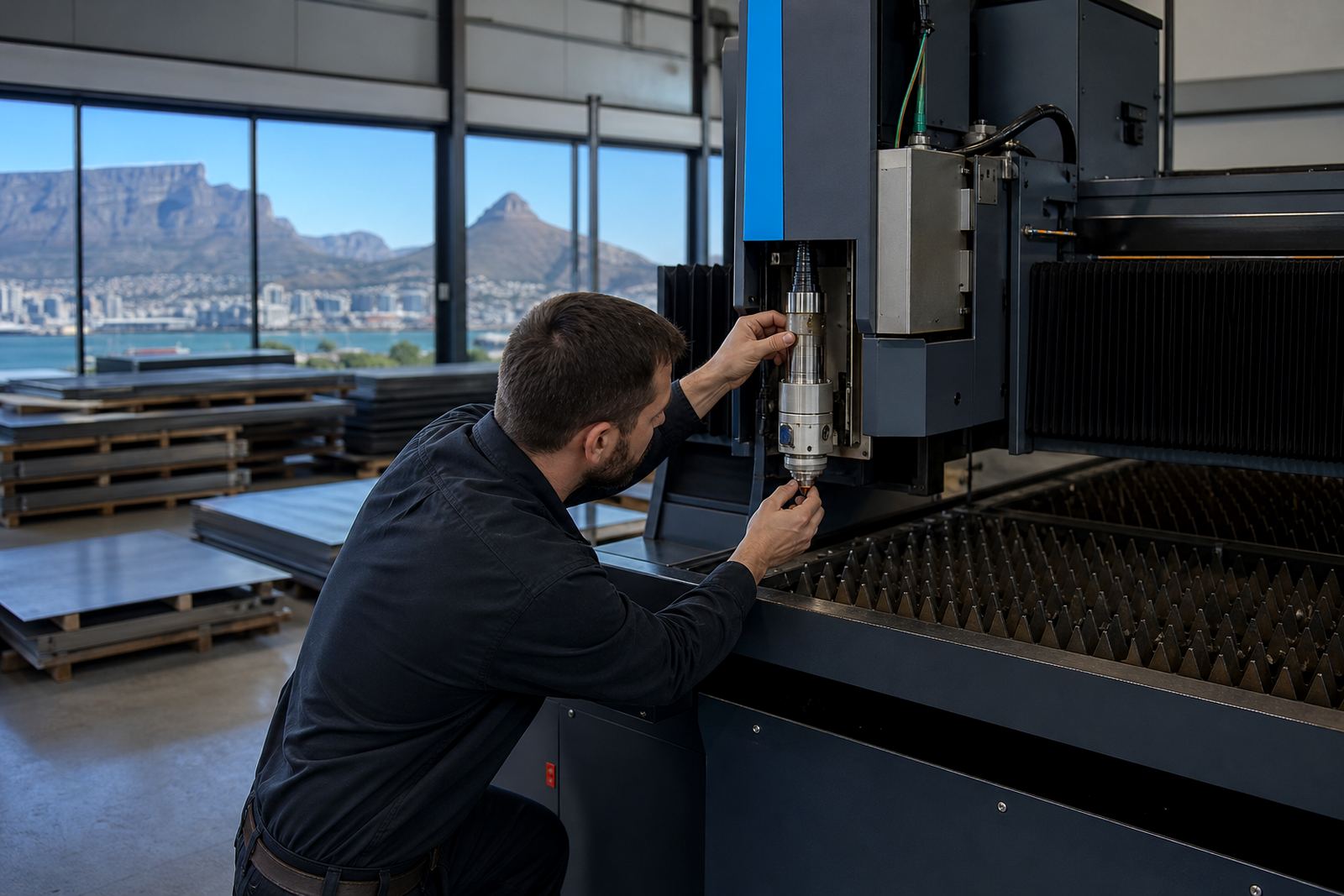
After the bench work, the head went back to the trailer workshop for on-site alignment. That matters when a machine has already shown cut instability on thicker steel, because the final setting has to be matched to the real cutting conditions on that floor. We set the nozzle position, rechecked the focus behaviour and watched the height sensing response while the operator ran test cuts on the same type of plate that had caused trouble.
The aim was a cleaner pierce, better edge consistency and less wandering at the start of the cut. We kept the setup practical: no fancy adjustments that only look good on paper, just the settings needed for the workshop to keep working with a steadier head and less interruption from dirty optics or poor centring.
- Alignment checked under the machine’s working setup
- Test cuts used the workshop’s thick structural sheet
- Focus setting adjusted for cleaner start points
- Height sensing checked against real cutting movement
The practical result on the cut table
Once the cleaned parts were back in place and the alignment settled, the machine produced a more even cut edge on the thicker sheet it was known to struggle with. The pierces settled down, the nozzle marks were less erratic and the operator had a clearer read on where the head was sitting during the cut. For a trailer shop, that means less rework on brackets and fewer parts that need dressing before assembly.
There was also a useful side effect: the workshop could see the difference between a consumable issue and a head issue. That saves a lot of trial and error when the work is heavy enough to punish weak settings. The cleaned optical path and the corrected nozzle centring gave the machine a better starting point, and the crash inspection helped rule out a hidden fault that could have grown into a bigger repair.
- Sharper pierce behaviour on thicker structural sheet
- Cleaner edge line on repeated test parts
- Better nozzle centring after bench work
- More stable height sensing during cutting
What we would bring into the next laser cutting head service
For a trailer shop doing regular heavy fabrication, the strongest approach is to inspect the head before the optics get blamed for every cut fault. If the nozzle is not centred, the focus is off, or the ceramic ring is damaged, the machine can waste good material very quickly. A clean head with correct alignment gives the operator a fair starting point before cutting begins on thicker plate.
On a similar job, we would again begin with the bench service, then move to on-site alignment once the optical path and wear points are under control. That mix works well for workshops that cut structural material and cannot afford unnecessary stoppages from a hidden head fault. It also keeps the gas path, lenses and sensing parts in the same conversation, which is where they usually belong.
- Start with bench cleaning before chasing settings
- Inspect the crash path, not only the nozzle tip
- Reset focus against the material thickness in use
- Finish with field alignment on the actual machine
Key facts
| Project | Benoni Trailer Shop |
|---|---|
| Town | Benoni, East Rand |
| Machine area | Fibre laser cutting head service |
| Work carried out | Bench cleaning, crash inspection, nozzle centring, focus setting check, on-site alignment |
| Parts handled | Nozzles, protective window, ceramic ring, focus lens, collimator lens |
| Material focus | Thicker structural sheet for trailer fabrication and repair |