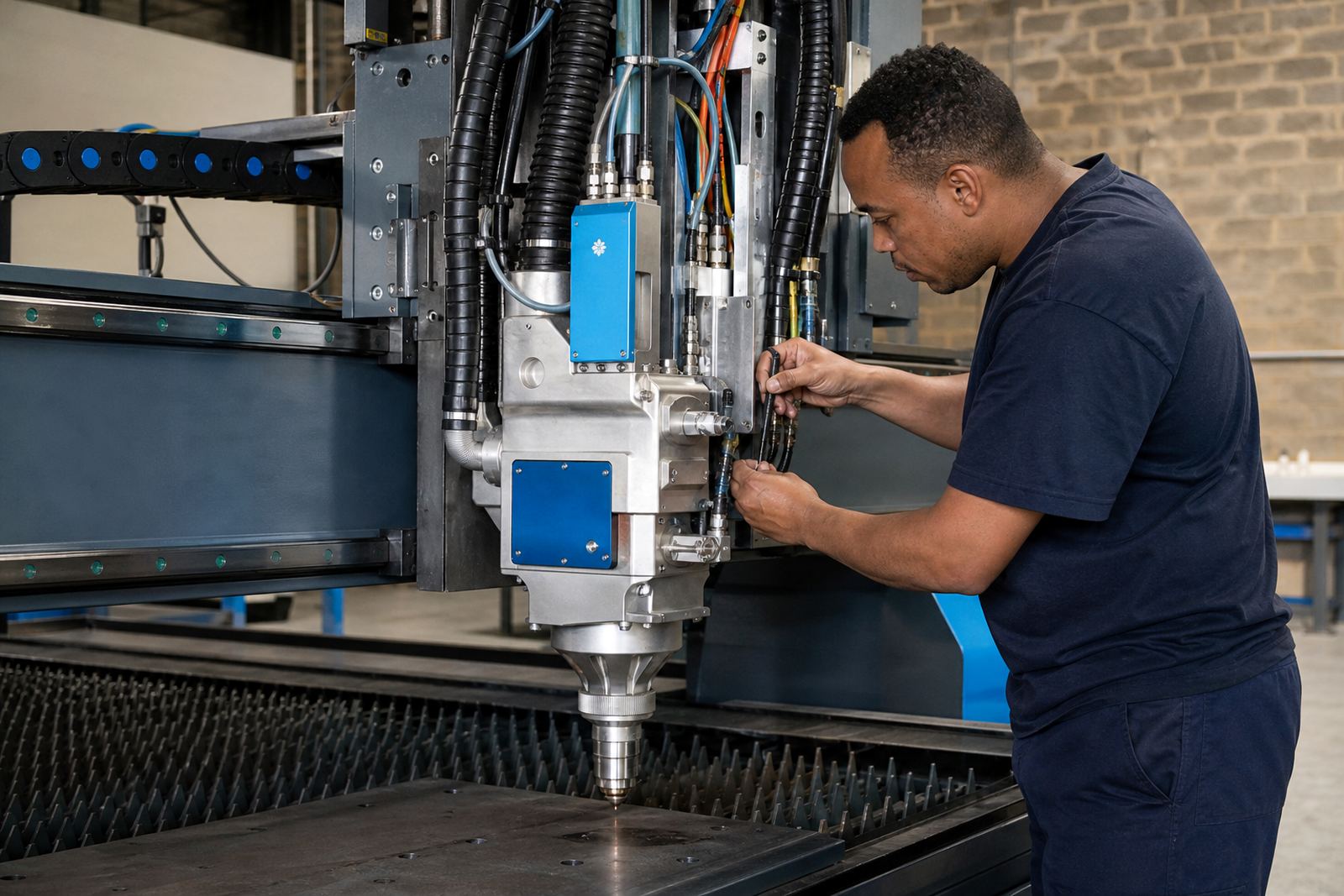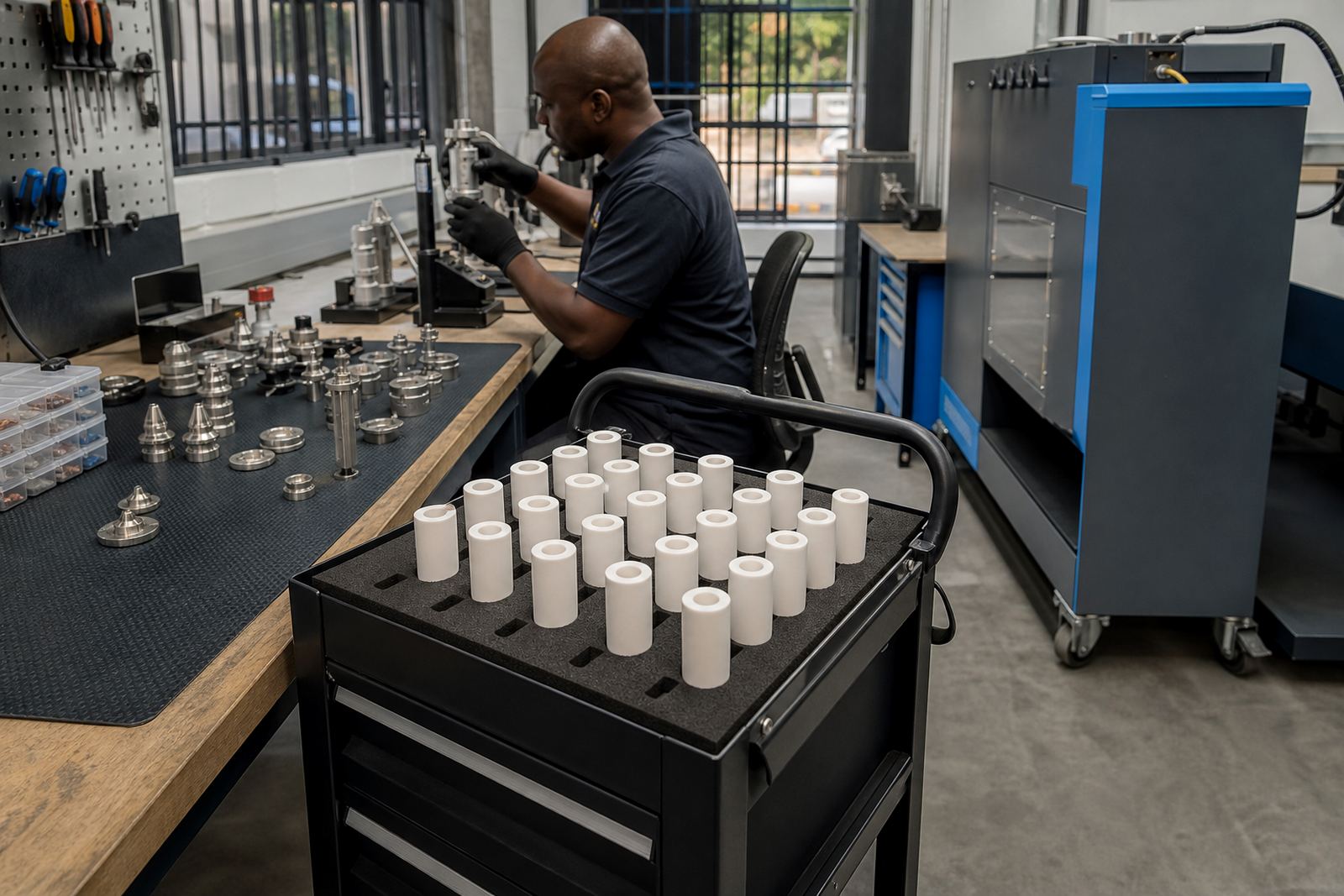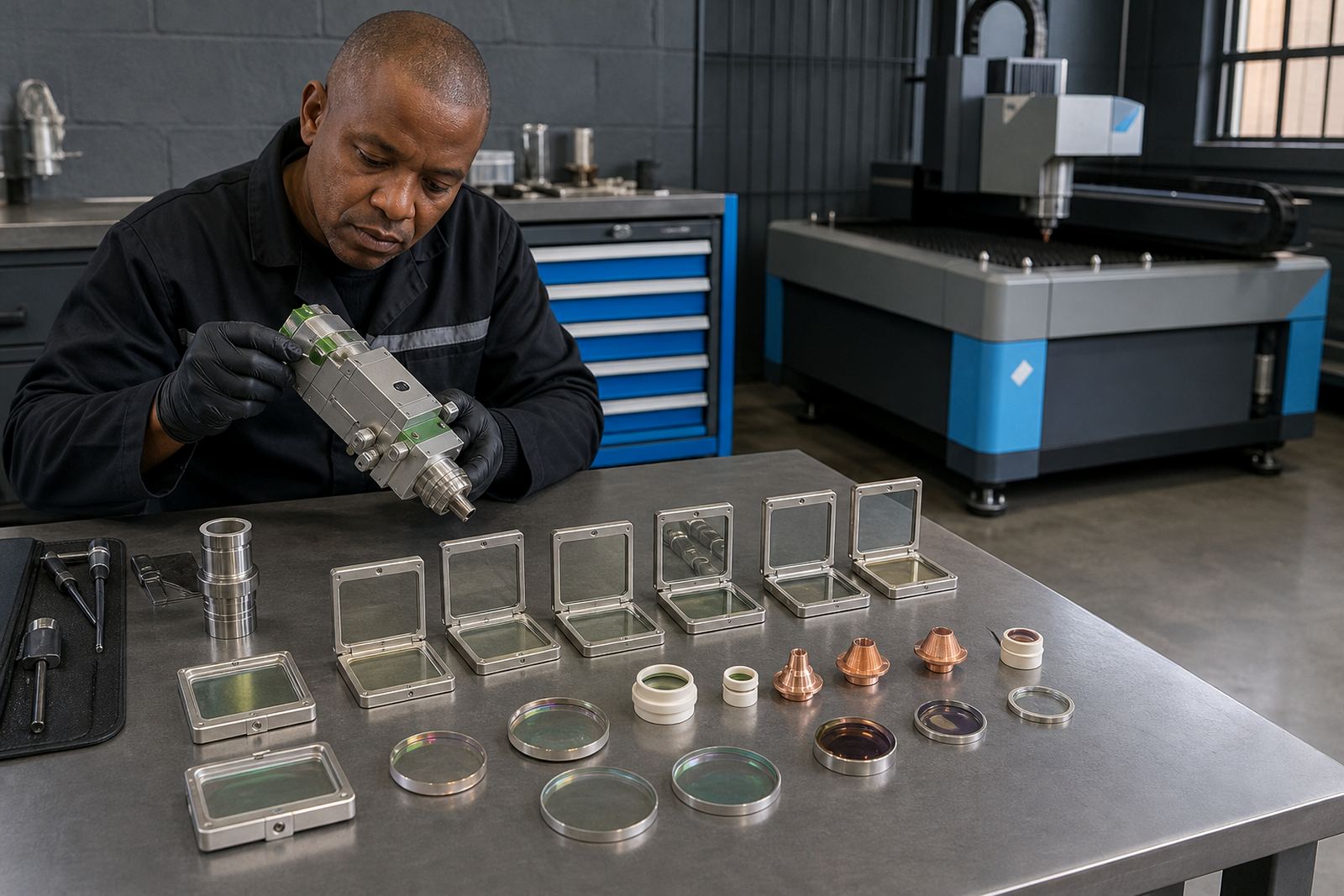
Inside the cutting head, the cassette holds and shields the optic parts that guide the laser beam.
A window cassette is the carrier that holds the protective window in front of the optical path on a fibre laser cutting head. It gives the technician a defined seat for the glass, seal surfaces for the ring or gasket, and a neater way to remove and refit the window during routine service or after a splash of smoke, dust, or dross has worked its way into the head. In a busy cutting bay, that matters because the window is the first line between the beam path and the dirt that rides on the air around sheet-metal cutting.
We work with cassettes used on heads that run clean assist gas and close focus settings on mild steel, stainless steel, aluminium, and coated sheet. The part itself is small, but the fit is not. The seat must stay square, the retaining face must be even, and the cassette must line up with the optical axis so the beam passes through the centre without clipping or stress on the window edge.
- Holds the protective window in a fixed carrier
- Helps keep handling marks off the glass surface
- Supports faster change-out during bench service
- Works with cleaning and inspection routines on the head
Cassette sizes and build details we check
Window cassettes are matched to the head body and to the diameter and thickness of the protective window. The common choices are round carriers with a metal or composite body, an O-ring or seal groove, and a retaining face that clamps the window without distorting it. Some heads take a shallow cassette, others use a deeper carrier where the window sits further back from the nozzle end. The wrong depth can upset focus position and make the seal sit unevenly.
When a shop orders cassettes, the useful details are the outer diameter, inner seat diameter, glass thickness, seal type, thread or lock style, and whether the head uses a single cassette or a paired front and rear arrangement. We also check whether the slot is meant for a standard protective window or a higher heat load version used with heavier duty cutting cycles. On higher power machines, the condition of the cassette matters more because heat, dust and back reflection can show up faster at the window face.
- Outer diameter and seating depth
- Window diameter and thickness
- Seal groove or gasket style
- Locking method, thread, clip or retainer
- Head model and optical stack layout
Where window cassettes earn their keep
Window cassettes suit sheet-metal shops that cut in short runs, mixed materials, or heavy production where the head is opened often for cleaning, lens checks, and nozzle work. They are useful where fine dust, mill scale, oil mist, or cutting fumes can mark the window face. Coastal air can add another layer of grime, especially in Durban or Cape Town, where moisture and airborne salt can sit on exposed parts if the head is not sealed and handled carefully.
They also fit shops that need tighter control over maintenance on fibre laser cutting heads with capacitive height sensing and close nozzle-to-sheet gaps. If the window is not seated cleanly, the optical path can shift enough to affect cut edge quality, pierce stability, and focus repeatability. A good cassette helps the technician keep the window change neat and the head ready for the next setup without forcing the glass into a crooked seat.
For jobbing shops, repair bays, and plants that cut plate and sheet on a daily cycle, the cassette is part of the wear pattern. It is more than a holder, because it forms part of the protection setup that keeps the lens stack cleaner and service work better controlled.
Fitting notes for bench service and site work
Window cassette fitting is usually done during head servicing, seal rebuilds, or after contamination has been found around the front end of the head. The cassette should sit flat, with the seal compressed evenly all round and no twist in the carrier. If the retaining face is dirty or scored, the new window can inherit that problem at once. That is why the seating surfaces are cleaned before refit, and the edge of the glass is handled without touching the optical face.
On some heads the cassette is fitted on the bench while the rest of the optics are checked for dust, beam marks, or seal damage. On site, the same part may be changed as part of a larger alignment or service visit where the nozzle centring, focus setting, and capacitive sensor check are also on the list. The cassette itself does not need power or gas, but it has to fit properly within the head and respect the rest of the assembly around the nozzle end.
- Clean the seat before the new cassette goes in
- Check the seal face for nicks or burrs
- Handle the window by the edge only
- Confirm the carrier sits square in the head
- Inspect after first cut for smoke marks or uneven sealing
Care, cleaning and change-out discipline
Good care starts with keeping the cassette area free of dust, oil film and metal fines. Use lint-free wipes and the cleaning method suited to the optical glass in the head, then inspect the seat under clean light. If there are small chips, haze, or heat marks on the carrier edge, replace the cassette rather than forcing another window into a tired seat. A clean cassette protects the window, and a clean window protects the lens stack behind it.
In regular maintenance, the cassette is best treated as a controlled wear part. If the head has had a crash, a nozzle strike, or a bad pierce that sent debris back toward the front end, the cassette should be checked with the rest of the head. Keep spare cassettes sealed in their packing until needed, and store them away from grinding dust, moisture and loose fibre from rags or cardboard. Keeping to that small habit prevents bigger trouble later on.
- Wipe only with approved optical cleaning material
- Keep spare cassettes sealed and dry
- Replace damaged seals, not only the glass
- Inspect after crash events or heavy smoke exposure
Order details that keep the fit right
To match a window cassette correctly, send the head model details, the window size, the seal style, and whether the unit is for bench service or field fitting. If the head has a standard or high power optical stack, that should be stated too, because the cassette depth and window grade can differ. It also helps to note if the machine works in a stainless shop, a mixed material line, or a harsher coastal environment where moisture and fine dust shorten service intervals.
For a clean match, confirm the following before ordering: the cassette outer diameter, the window diameter and thickness, the retaining method, the seal type, and whether the part is for the front or rear position in the head. If the old part is available, a clear sample helps with comparison. The goal is a carrier that seats properly, protects the optics, and fits into the maintenance routine without extra forcing or shimming.
Our contact form is used for enquiries about cassette matching, bench service, on-site head alignment and spare-head preparation for sheet-metal shops across Spartan, Kempton Park, Johannesburg, Pretoria, Rustenburg, the East Rand, Durban and Cape Town
Key facts
| Product type | Fibre laser cutting heads use a protective window cassette |
|---|---|
| Use | Carries and protects the protective window in the front optical path |
| Common fit details | Outer diameter, window diameter, window thickness, seal groove, locking style |
| Service context | Bench head service, protective window replacement, head alignment |
| Typical environment | Sheet-metal cutting on mild steel, stainless steel, aluminium and coated sheet |
| Handling notes | Keep the seat clean, the seal even, and the optical face free of marks |