
What the head body assembly carries inside the cutting head
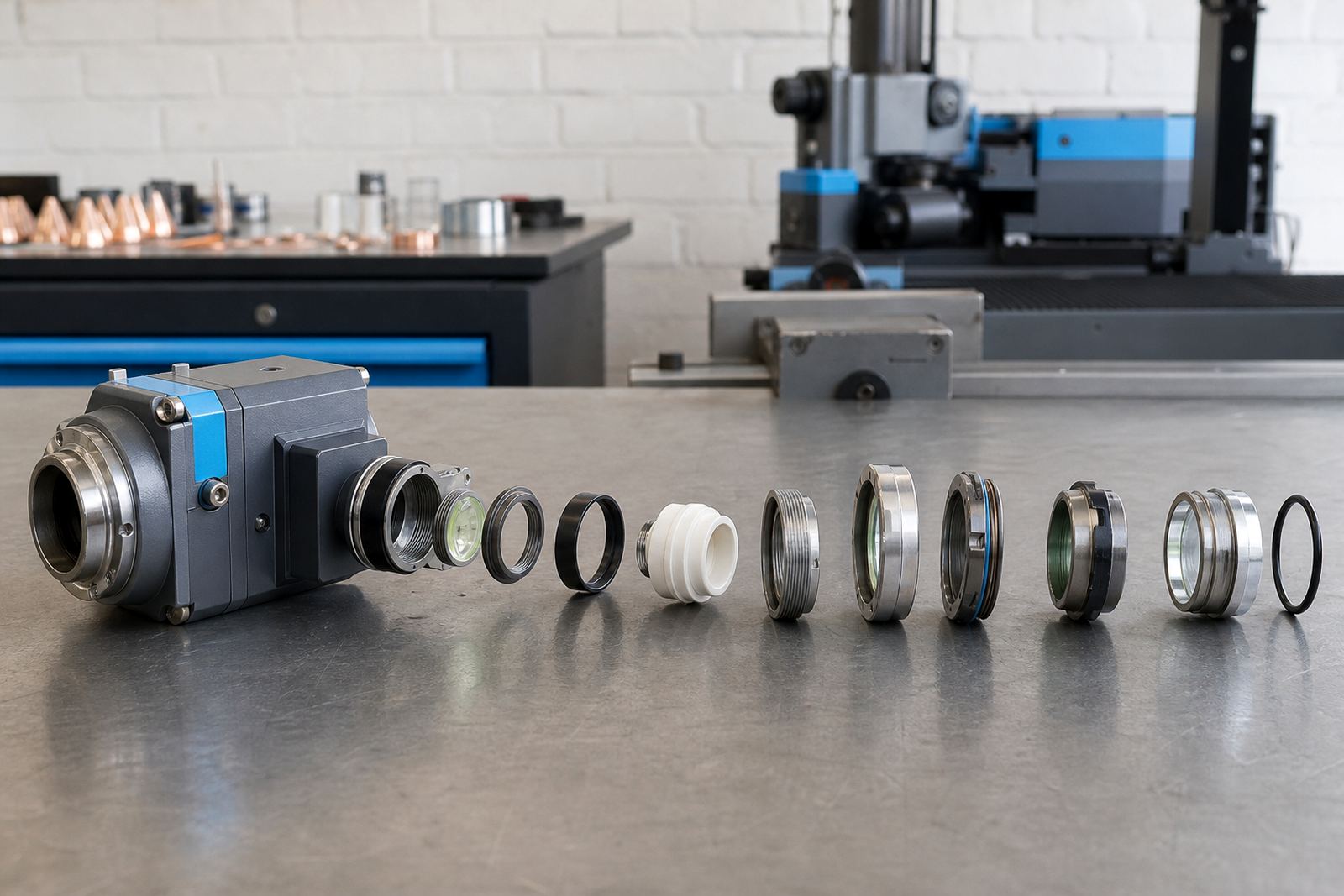
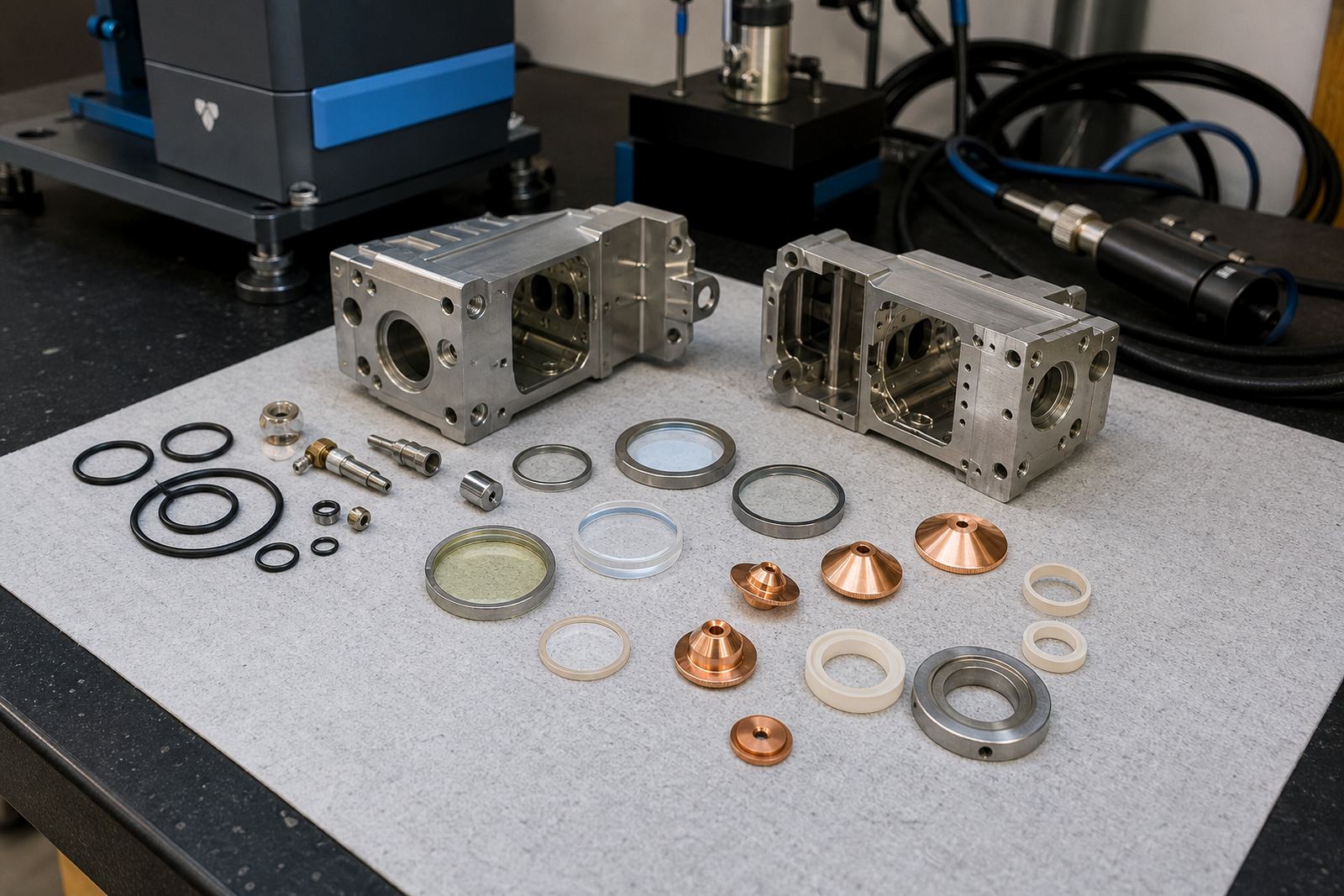
This assembly is the structural centre of the cutting head. It supports the lens seat, the nozzle holder, the ceramic ring, the sensor interface and the sealing points that keep the optical path and gas path working in the right position. In a sheet-metal shop the body has to hold its shape under heat, vibration and repeated head changes, because even small movement can show up as poor pierce behaviour, taper or a rough edge.
We supply body assemblies for fibre laser cutting heads used on flat sheet work, with parts matched to common beam routes and nozzle styles. The body is not just a shell. It is the part that keeps the stack concentric and gives the technician a fixed reference when checking focus, nozzle centring and capacitive height sensing.
- Main mechanical housing for the optical stack and nozzle section
- Reference surfaces for lens alignment and sealing
- Mounting point for ceramic ring and sensor components
- Works with focus lenses, collimator lenses and protective windows
Sizes, ports and build choices that matter on a rebuild
Head body assemblies are not all the same. The bore size, mounting face, thread pattern, sensor window position and gas entry route have to match the cutting head that is being rebuilt. Some units use a compact body for tight machine clearances, while others need a longer form for heavier optical stacks or different nozzle and sensor layouts.
For a shop that cuts mild steel, stainless steel or aluminium, the body choice must suit the machine frame, the head mount and the laser source interface. On-site work often starts with the actual worn body, because a cracked seat or a chewed thread can tell the technician more than a model number written on its own.
- Common options include standard and extended body lengths
- Thread and collar styles vary by cutting head design
- Check sensor port position, gas inlet route and cable clearance
- Confirm lens seat diameter, nozzle holder fit and ceramic ring size
When the body is replaced during a rebuild, the matching parts should be checked as a set. A new body with worn seals or a damaged nozzle seat will not hold alignment for long, and the same is true if the lens pocket has been marked by a previous crash.
Where this assembly fits in real sheet-metal work
The head body assembly suits laser cutting lines where fine nozzle positioning and clean optics matter every shift. It is used in fabrication shops that cut brackets, panels, enclosures, access covers and general sheet parts, especially where edge finish and pierce consistency are part of the job.
In Johannesburg and Pretoria, it often comes in with heads that have taken a small crash on dropped sheet or misread height sensing. In Durban and Cape Town, humidity and dusty air can add to wear on seals, sensor faces and threads. Rustenburg shops often bring in heads after heavy production runs where alignment has drifted and the body no longer holds the optical stack square.
The assembly suits work where the cutting head must sit close to the sheet and maintain a steady stand-off while the nozzle, lens and ceramic ring remain concentric. If the body is off centre, the gas stream can wobble and the cut starts to show roughness, dross or flare at the corner.
Fitting, bench checks and on-site alignment work
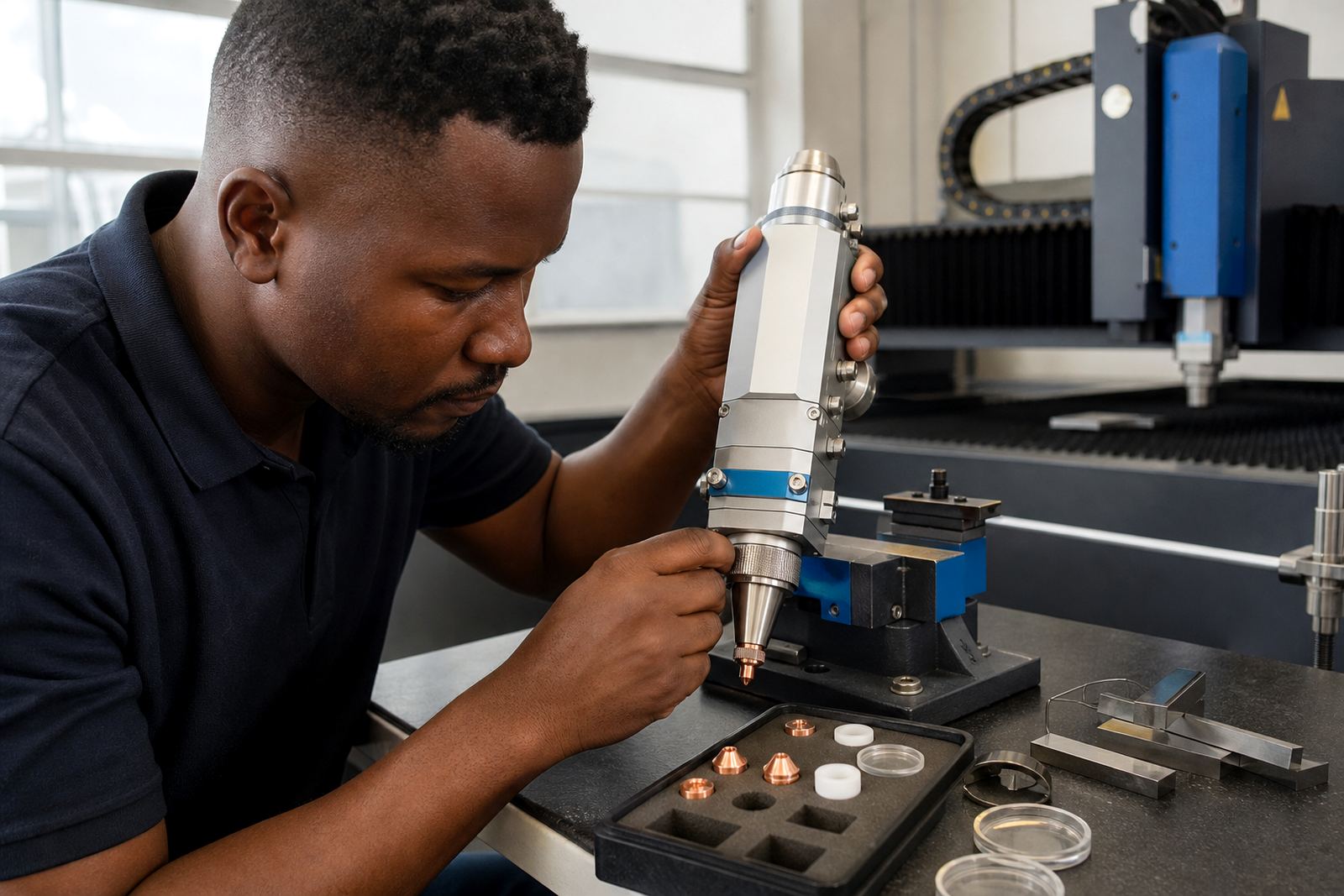
Fitting a head body assembly is a bench job first, then a machine job. The technician checks the seating faces, cleans the optical pockets, verifies the focus setting range and confirms that the ceramic ring, nozzle holder and sensor parts sit without binding. A rebuild should also include a gas path inspection, because dirt or a damaged seal can mask the real fault.
On-site alignment is used when the machine cannot be stripped easily or when the full head needs to be set in place after a crash. That work covers nozzle centring, focus setting check, capacitive sensor check and the final mechanical alignment of the body on the machine mount. If the mounting points are not square, the nozzle may look centred on the bench but shift under live motion.
- Bench service for inspection, cleaning and fit-up checks
- On-site alignment for installed heads and machine-mounted bodies
- Head seal rebuild where the sealing faces are still serviceable
- Crash damage inspection before a body is refitted
Clean handling matters. A finger mark on a lens seat, a loose ceramic ring or a burr on a thread can change the reading by a small amount and that is enough to disturb the cut. In practice, the fitting work is done with measured handling, clean cloths and the right tools for the thread size in front of the technician.
Care, cleaning and wear points after installation
Once the body assembly is in service, the main care points are the sealing faces, thread condition, gas passages and the areas around the sensor. A body that sees regular smoke, fine dust or splashback should be checked during lens cleaning and nozzle service, because residue tends to build up where the air path narrows.
A good cleaning routine uses dry, clean methods for the optical seats and a careful wipe on the external surfaces. Aggressive scraping can damage the body more than the dirt did. If the machine has repeated crash marks on the nozzle side, the ceramic ring and nozzle holder should be checked with the body, not after the next fault shows up.
- Keep threads clean and free from burrs
- Check seating faces after any head contact or crash
- Inspect gas passages for soot, dust and moisture marks
- Watch for looseness around sensor fittings and seals
In coastal areas, stored parts should stay dry and sealed where possible. In inland shops, fine metallic dust is often the bigger problem. Either way, the body lasts better when it is not left open on the bench between jobs.
Order details that help match the right body assembly
When ordering a head body assembly, the useful details are the head model, the laser cutting head type, the bore and thread measurements, the mounting style and the parts that sit inside the body. If the old unit has crash marks, share clear notes on where the damage sits, because that changes whether the body can be rebuilt or needs full replacement.
Please include the size of the lens seats, nozzle holder format, ceramic ring diameter, gas inlet arrangement and the sensor layout. If the head uses a particular focus travel range or a different protective window stack, that also helps with matching. For shop floor planning, it helps to know whether the head is going back into regular cutting, fine-detail work or thicker sheet production.
Our team in Spartan, Kempton Park manages supply, bench service and on-site alignment across Johannesburg, Pretoria, Durban, Cape Town, Rustenburg and the East Rand. The aim is to put the body assembly back into a straight, workable head that can hold optics, gas and sensor parts where they belong.
Key facts
| Product type | Main mechanical body assembly for fibre laser cutting heads |
|---|---|
| Use | Rebuilding or replacing worn head structures on sheet-metal cutting machines |
| Typical compatibility | Matches the body, lens seat, nozzle and sensor layout of the existing cutting head |
| Material form | Precision-machined metal body with optical and gas-path interfaces |
| Service options | Bench Head Service, On-site Head Alignment, Head Seal Rebuild |
| Supply area | Spartan, Kempton Park with coverage in Johannesburg, Pretoria, Durban, Cape Town, Rustenburg and the East Rand |